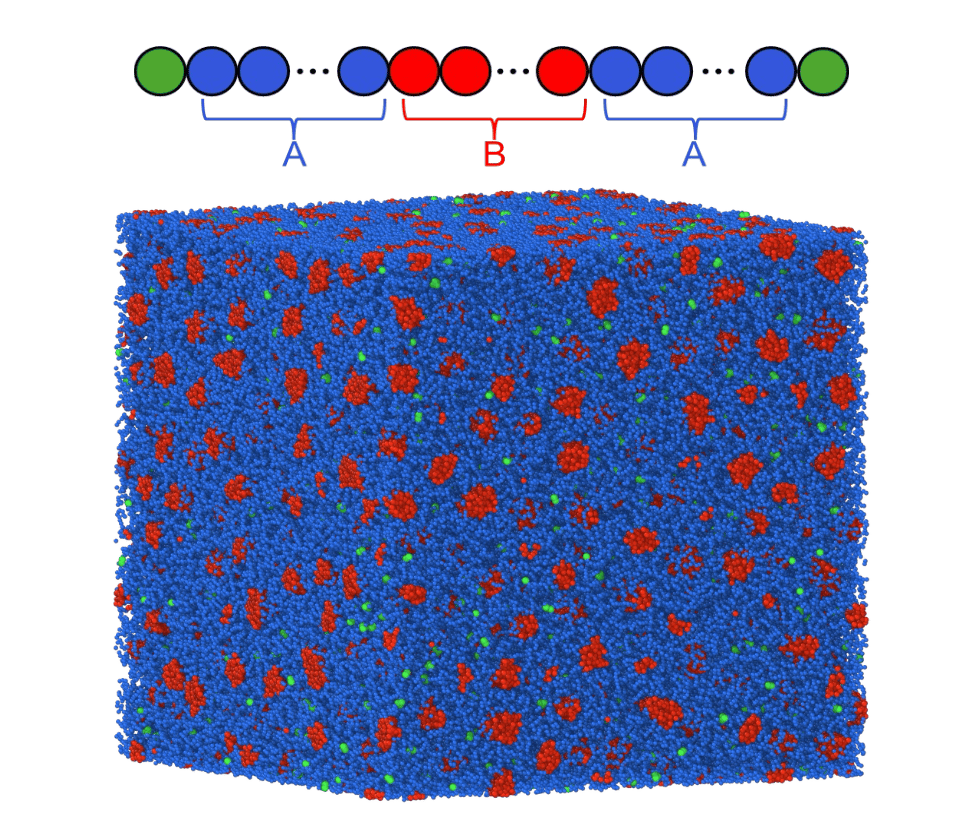
Pluronic-based hydrogels are promising materials for hosting polymer and protein-based microcompartments that can act as artificial cells. However, their limited mechanical strength and toughness limits practical applications as tissue scaffolds or media for transport and storage of molecules or microcompartments. Creating densely connected molecular network structure can improve the network toughness by allowing for uniform load distribution among micelles. By oligomerizing Pluronic F127 polymer chains, Northwestern University MRSEC IRG-1 has developed Pluronic-based hydrogels that improve micellar connectivity and show increased toughness under uniaxial tensile loading. Experiments and coarse-grained molecular dynamics simulations reveal that the multi-block chains of oligomerized Pluronic participate in multiple clusters and increase micellar connectivity. Graph theory structural analysis reveals that micellar connectivity leads to robust polymer network structure with increased resistance to fracture under tensile loading. Overall, this work develops a method for improving mechanical properties of Pluronic-based micellar hydrogels to strengthen their position as artificial cell materials.
 Download

Northwestern Materials Research Science and Engineering Center
NU-MRSEC advances world-class materials research, education, and outreach via active interdisciplinary collaborations within the Center and with external partners in academia, industry, national laboratories, and museums, both domestically and abroad.