Active systems composed of energy-generating microscopic constituents are a promising platform to create autonomous functional materials that can, for example, locomote through complex and unpredictable environments. Yet coaxing these energy sources into useful mechanical work has proved challenging.
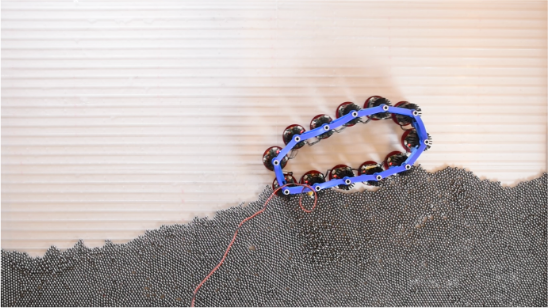
In this study, active solids were built out of centimetre-scale building blocks that perform adaptive locomotion. These prototypes exhibit a non-variational form of elasticity characterized by odd moduli, whose magnitude was predicted from microscopics using coarse-grained theories validated experimentally.
As a result, these chiral active solids are able to accelerate, adjust their gaits and locomote through a variety of terrains with a similar performance to more complex control strategies implemented by neural networks. This work establishes active solids as a bridge between materials and robots and suggests decentralized strategies to control the nonlinear dynamics of biological systems, soft materials and driven nanomechanical devices.
 Download

UChicago Materials Research Center (2020)
The UChicago MRSEC pioneers frameworks for materials discovery, focusing on trainable soft materials, activated architectured materials with dynamic transport properties, and quantum transduction for integrated circuits.