Surface plasmons - collective oscillations of free charges - on metal surfaces have resulted in demonstrations of enhanced optical transmission, collimation of light through a subwavelength aperture, negative permeability and refraction at visible wavelengths, and second-harmonic generation. The structures that display these plasmonic phenomena typically consist of ordered arrays of particles or holes with sizes of the order of 100 nm. At the NU-MRSEC, a new nanofabrication technique based on soft interference lithography was used to manufacture multiscale arrays of nanoparticles and nanoholes with unexpected optical properties. 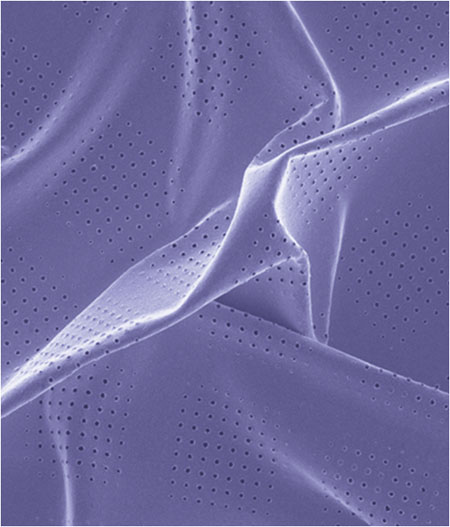
This scanning electron microscopy image depicts a free-standing gold film perforated with 100-nm holes patterned in microscale patches.

Northwestern Materials Research Science and Engineering Center
NU-MRSEC advances world-class materials research, education, and outreach via active interdisciplinary collaborations within the Center and with external partners in academia, industry, national laboratories, and museums, both domestically and abroad.