When a negatively charged, high molecular weight polymer (hyaluronic acid) is mixed with a positively charged peptide-based, self-assembling molecule, a membrane is instantaneously formed at the interface of the two solutions. These closed membranes (sacs) have a complex hierarchical structure which presents a unique challenge in quantifying its mechanical properties. Membrane inflation and osmotic swelling techniques have been used to quantitatively characterize the membrane properties. These findings will be essential for tailoring the membrane characteristics for specific future applications.
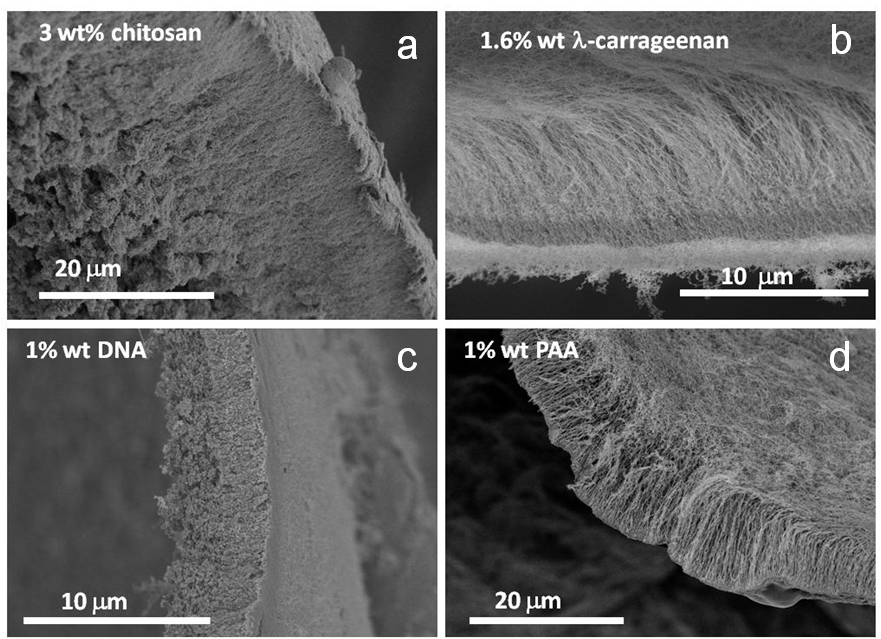
SEM micrographs of hierarchically ordered membranes formed with chitosan mixed with negatively charged peptide (a); λ-carrageenan (b), DNA (c) and poly(acrylic acid) (d) mixed with positively charged PA.

Northwestern Materials Research Science and Engineering Center
NU-MRSEC advances world-class materials research, education, and outreach via active interdisciplinary collaborations within the Center and with external partners in academia, industry, national laboratories, and museums, both domestically and abroad.