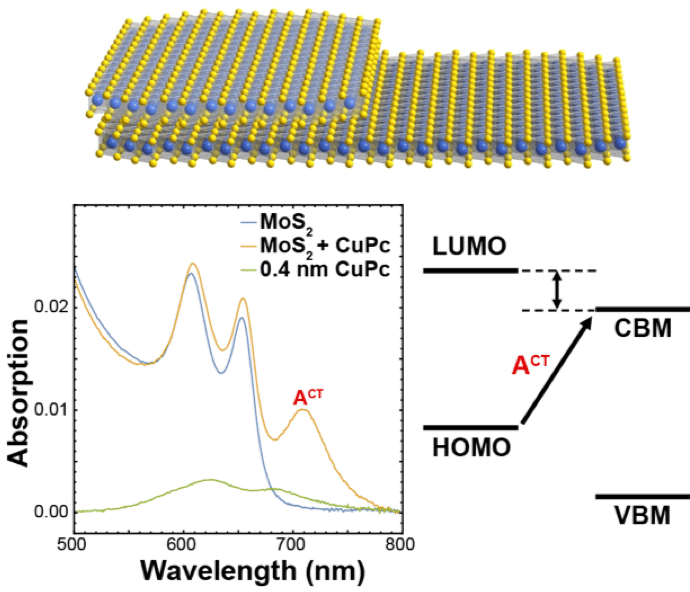
Heterojunctions containing two-dimensional materials can give rise to unique effects at the interface or enhance existing optical properties of the composite layers. Using organic molecules in these heterojunctions has the advantage to enable synthetically tunable electronic and optical properties. The combination of 2D transition metal dichalcogenides with pthalocyanines (Pc), organic dye molecules consisting of an aromatic macrocycle bonded to a metal core atom has been explored. In particular, a new low-energy absorption peak in Pc-MoS2 heterojunctions emerges due to charge transfer interactions between the adsorbed molecules and the 2D substrate, revealing the importance of band and energy level alignment on mixed-dimensional interfaces.
 Download

Northwestern Materials Research Science and Engineering Center
NU-MRSEC advances world-class materials research, education, and outreach via active interdisciplinary collaborations within the Center and with external partners in academia, industry, national laboratories, and museums, both domestically and abroad.