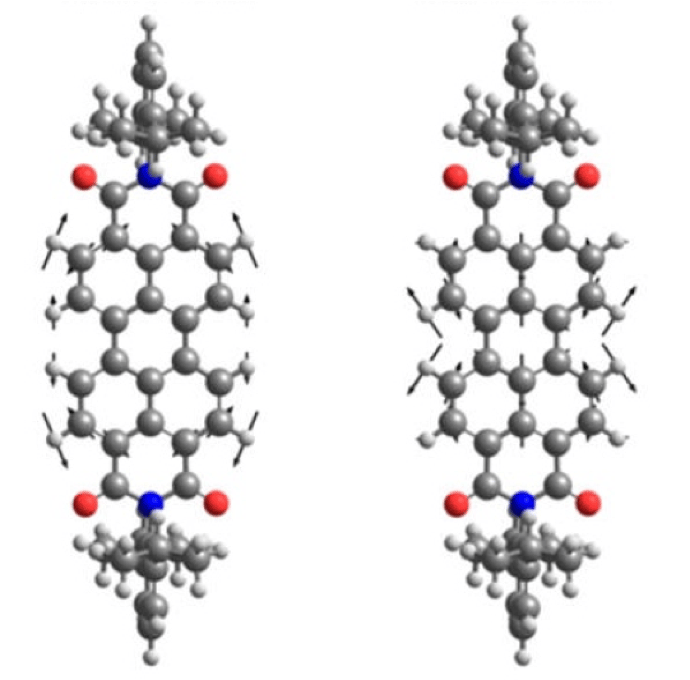
At the nanometer-scale, the surface area to volume ratio increases substantially compared to bulk materials. Consequently, methods for functionalizing and passivating surfaces can play a dominant role in determining the properties of nanomaterials. Of particular interest are self-assembled monolayers of organic molecules that have been widely used to control the electronic, optical, chemical, and frictional properties of nanomaterials in a range of applications. To elucidate the fundamental chemical interactions in self-assembled monolayers, correlated ultrahigh vacuum tip-enhanced Raman spectroscopy and time-dependent density functional theory have been employed. This novel methodology provides direct insight into the strength of intermolecular interactions in self-assembled monolayers, ultimately probing surface-bound organic molecules with unprecedented intramolecular resolution.
J. Am. Chem. Soc. 139, 18664 (2017).
 Download

Northwestern Materials Research Science and Engineering Center
NU-MRSEC advances world-class materials research, education, and outreach via active interdisciplinary collaborations within the Center and with external partners in academia, industry, national laboratories, and museums, both domestically and abroad.