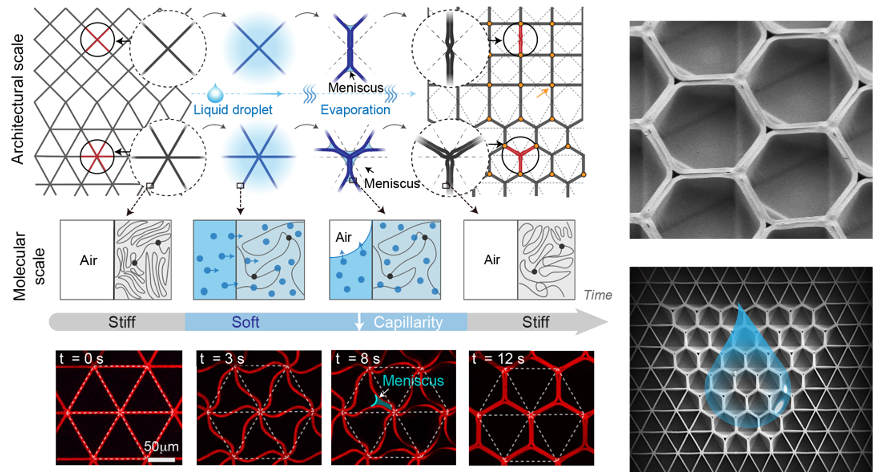
 A team at the Harvard MRSEC led by Aizenberg and Bertoldi has developed a dynamic design strategy to achieve topological transformations of two-dimensional polymeric cellular lattices in a reversible and controllable manner through exposure to different liquids. Guided by a theoretical model that connects lattice geometry, material stiffness, and capillary forces, they created lattices with programmed shape transformations that undergo fast global or localized deformations in response to different liquids. The observed shape changes provide a platform for studying material–topology–dimension interactions and open new avenues to applications in information encryption, selective particle trapping and bubble release, as well as tunable mechanical, chemical and acoustic properties.
 Download

Harvard Materials Research Center (2020)
The Harvard MRSEC focuses on unraveling complex phenomena in soft materials with the goal of translating these advances to benefit society.