
The Harvard Materials Research Science and Engineering Center (MRSEC) supports world-class research, education, and outreach activities (flyer) at the forefront of soft matter science through the auspices of the National Science Foundation.
Our two Interdisciplinary Research Groups (IRGs) seek to create new classes of soft functional materials and to provide new insights into the behavior of mechanically soft systems far from equilibrium. An important mission of the Center is to train and retain a diverse generation of students in materials science and engineering by cultivating innovation and entrepreneurship in our students, postdocs, and the whole community. By forging new scientific directions, the Center focuses on unraveling complex phenomena in soft materials with the goal of translating these advances to benefit society.
 Brochure
Programmable Multiscale and Multi-Material Control of Functional Matter
This IRG is aimed at fundamental advances in materials synthesis, modeling, and 3D printing that enable the creation of functional soft materials that augment human performance. New classes of soft materials that sense, actuate, and communicate are being developed for use in wearables, haptic interfaces, and artificial muscles connecting to U.S. National Science Foundation's 10 Big Ideas: Future of Work at the Human-Technology Frontier.
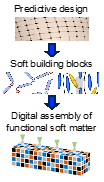
Figure 1. IRG 1 goals
To carry out the this research, we bring together a multidisciplinary research team composed of faculty members from applied mathematics, bioengineering, chemistry, materials, and mechanical engineering with deep expertise in theory and computation (Bertoldi, Kozinsky, Mahadevan, Rycroft, Suo), synthesis and assembly (Aizenberg, Clarke, Lewis, Parker, Vaia, Weitz), and characterization (Bertoldi, Clarke, Pindak, Suo, Walsh) to focus on three intertwined goals (Figure 1).
Establish predictive design rules that guide the synthesis and digital assembly of soft functional materials across multiple scales.
Synthesize soft building blocks composed of functional elastomers with controlled network architecture and stimuli-responsive moieties for creating soft functional materials.
Create functional soft matter via digital assembly that sense, communicate, and actuate in response to external stimuli for potential application at the human-technology interface.

Non-Equilibrium Phenomena in Mechanically Soft Systems
This IRG is pursuing new insights into the behavior of mechanically soft systems that are subjected to perturbations far from equilibrium. By combining data-rich experiments, theory, and artificial intelligence, the research will contribute greatly to U.S. National Science Foundation's 10 Big Ideas: Harnessing the Data Revolution by expanding its application to soft materials. While our focus is on soft materials, the insights gained will be broadly applicable to other classes of materials, spanning a wide range of length and time scales.
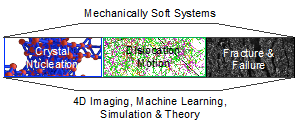
Figure 1. IRG 2 goals
To carry out the research, we bring together a multidisciplinary research team composed of faculty members from applied mathematics, biology, physics, chemistry, earth and planetary science, soft matter physics, and mechanical engineering with deep expertise in soft materials assembly (Lewis, Weitz, Whitesides), fracture mechanics (Holbrook, Rice, Suo), 4D confocal imaging and materials characterization (Spaepen, Vlassak), machine learning and computer simulation (Brenner, Colwell, Denolle, Frenkel, Kozinsky), and theory (Nelson) to focus on three goals that exploit data-driven science (Figure 1).
Understand crystal nucleation in single and multi-component hard-sphere systems and use the knowledge gained to develop new routes for creating alloys.
Investigate collective dislocation motion that underlies plastic deformation of materials.
Explore fracture phenomena in mechanically soft systems to understand their toughening, dissipation, and failure mechanisms.