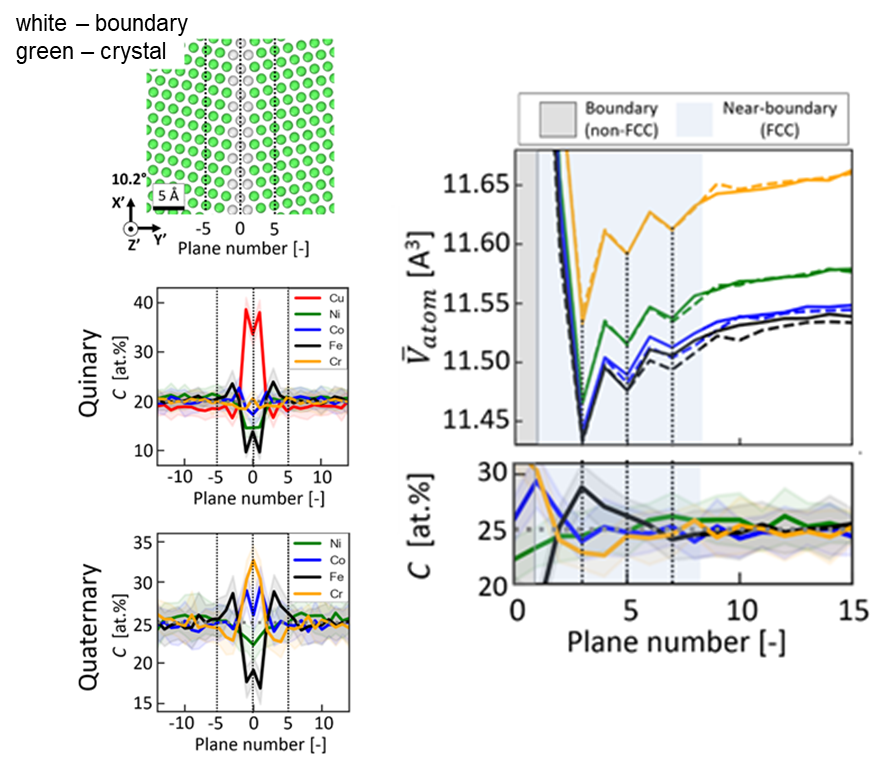
 Grain boundaries, interfaces between two crystals inside a material, are important defects which can dramatically alter material response because the structure of the boundary is different from the bulk crystalline region.
Using a unique set of metals called multi-principal element alloys (MPEAs), IRG-1 has shown that grain boundaries can have multiple levels of local structural and chemical heterogeneities that far surpass what was previously hypothesized. Not only does the boundary itself serve as a sink for dopants due to the local defects, but a thicker, near-boundary region has reduced free volume compared to the bulk and can be enriched in other atomic elements.
While the team discovered these unique near-boundary regions in MPEAs, they have shown that these features exist in simpler materials too, opening the door for a new yet widely-applicable materials design concept.
 Download
Center for Complex and Active Materials (2020)
The primary mission of he NSF MRSEC at UCI is to establish foundational knowledge in materials science and engineering of new classes of materials offering unique and broad functionality via an interplay among design, simulation, synthesis, and advanced characterization.