 Living cilia stir, sweep, and steer via swirling strokes of complex bending and twisting paired with distinct reverse arcs. Efforts to mimic their dynamics rely on multi-material designs, since programming arbitrary motion is difficult in single materials.
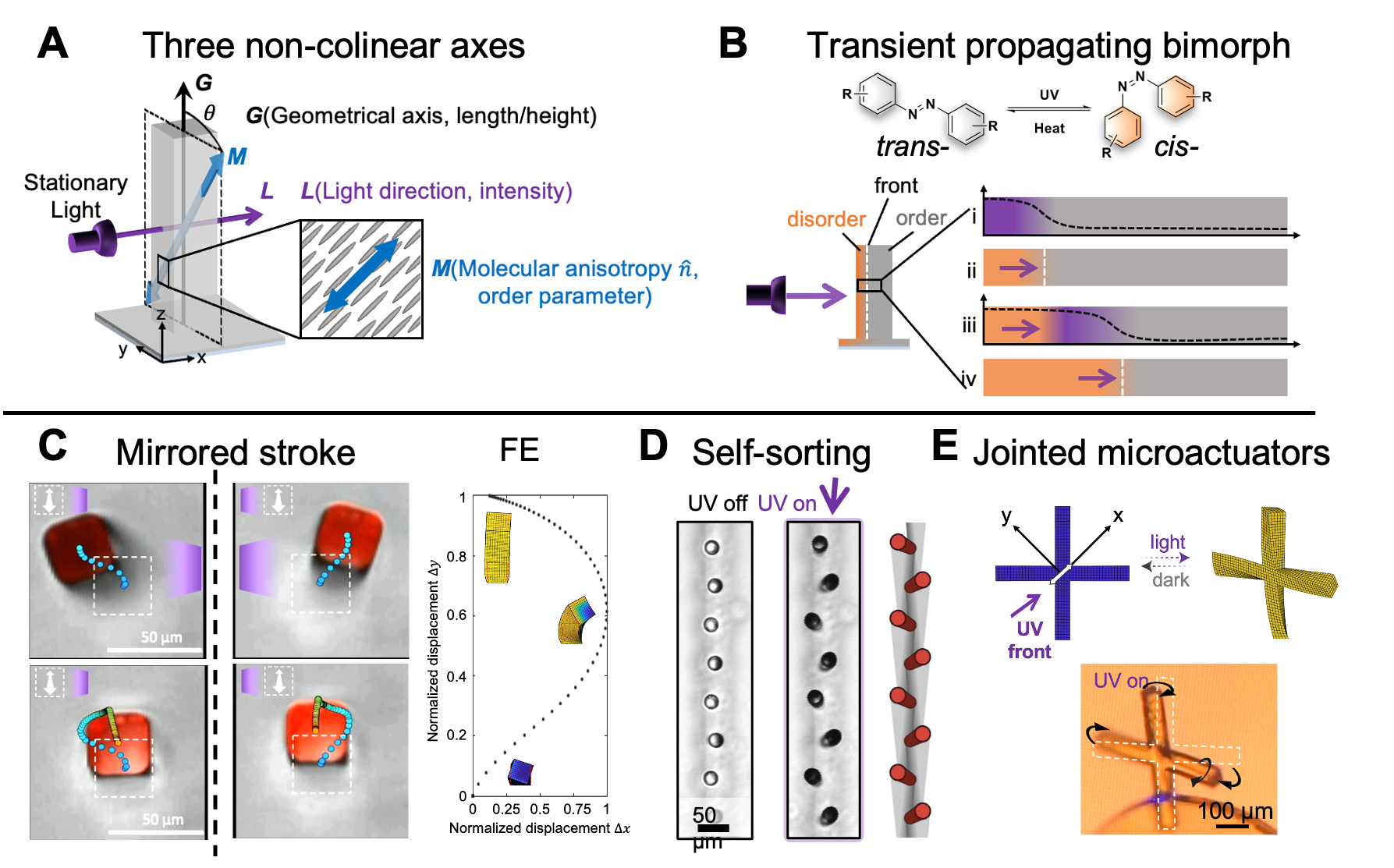
A team at the Harvard MRSEC led by Bertoldi and Aizenberg has developed an approach to achieve a diverse trajectories from a single-material system via self-regulation: when a photoresponsive liquid crystal elastomeric pillar with mesogen alignment is exposed to light, it ‘dances’ dynamically as light initiates a traveling order-to-disorder transition front that twists and bends via opto-chemo-mechanical feedback. Guided by a theoretical model, a wide range of trajectories are realized by tailoring light illumination, molecular anisotropy, and geometry. Furthermore, higher order dynamics emerge in micro-pillar arrays and jointed geometries, with broad implications for autonomous actuators used in soft robotics, biomedical devices, and energy transduction materials.
 Download

Harvard Materials Research Center (2020)
The Harvard MRSEC focuses on unraveling complex phenomena in soft materials with the goal of translating these advances to benefit society.