 Dissipative Self-Assembly
Fuel-driven self-assembly is ubiquitous in natural systems, leading to complex phenomena including cell motility, cell division, camouflage, and self-healing. Creating synthetic equivalents of these biological assemblies is challenging but offers the reward of active, dynamic materials.
Electrically-Fueled Assembly
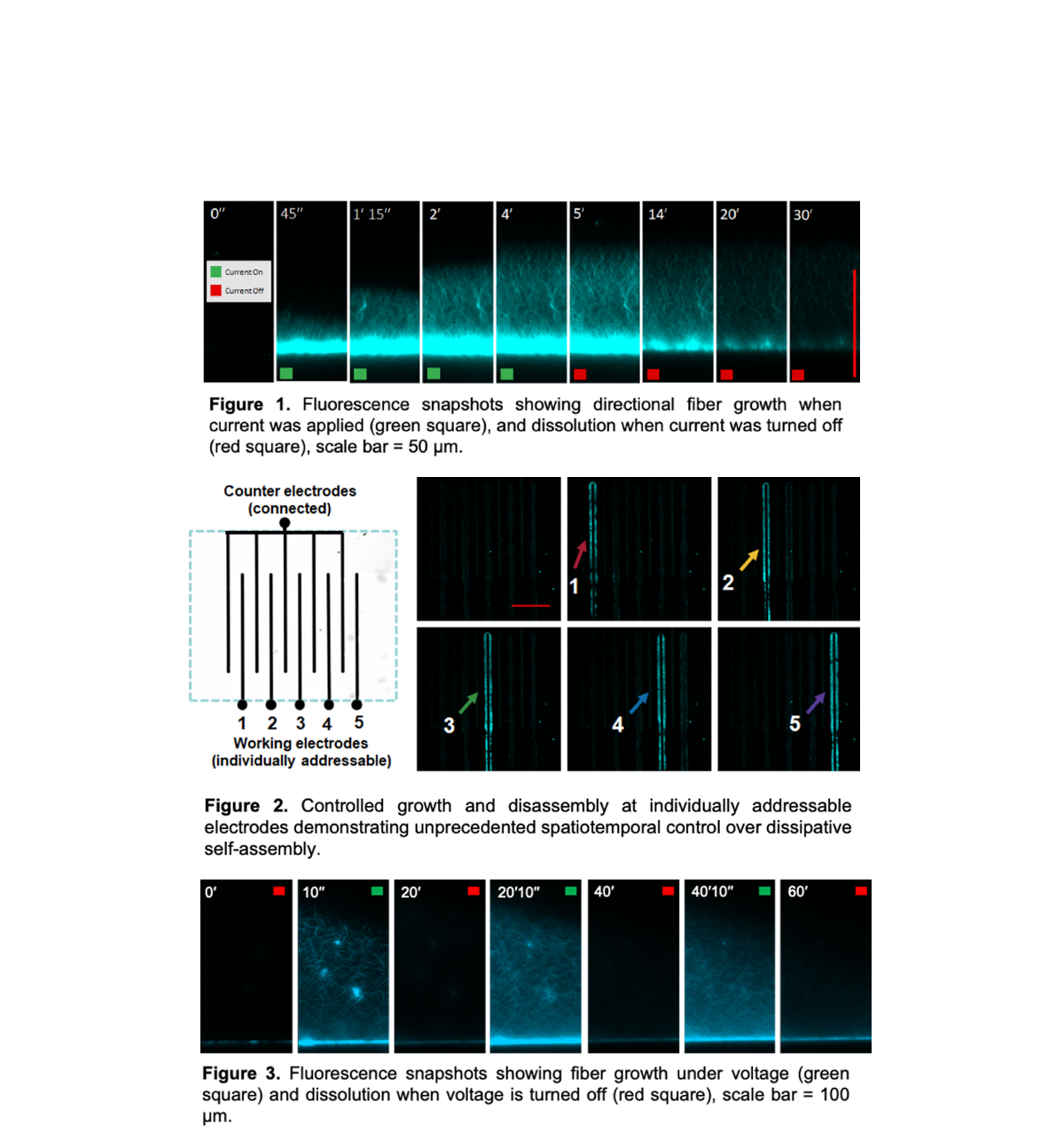
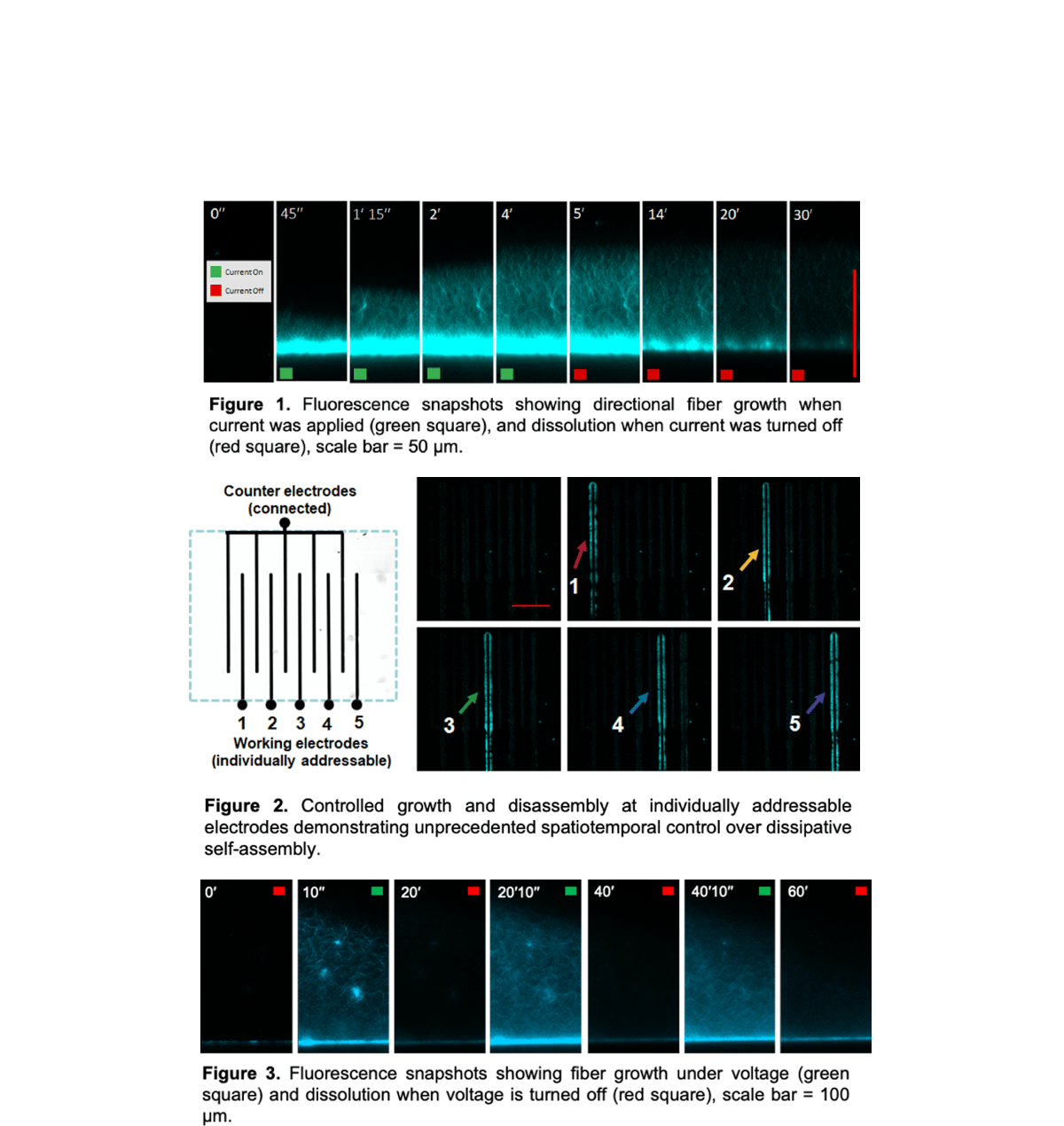
Current synthetic dissipative self-assembly systems are fueled either by chemicals or light. Here, the UCI MRSEC team have developed the first electrically-fueled dissipative system that offers rapid kinetics, directionality, and unprecedented spatiotemporal control, closely mimicking systems found in nature. The electrochemically-fueled active, dynamic, and directional assembly is shown in Figure 1. Excitingly, the system demonstrates an unprecedented level of spatiotemporal control of self-assembly (Figure 2).
The team is now working on expanding this chemistry to a completely waste-free dissipative system. The transient behavior of dissipative self-assembly using dual electrocatalysts without generating any waste has been preliminarily demonstrated (Figure 3).
 Download
Center for Complex and Active Materials (2020)
The primary mission of he NSF MRSEC at UCI is to establish foundational knowledge in materials science and engineering of new classes of materials offering unique and broad functionality via an interplay among design, simulation, synthesis, and advanced characterization.