Highlights

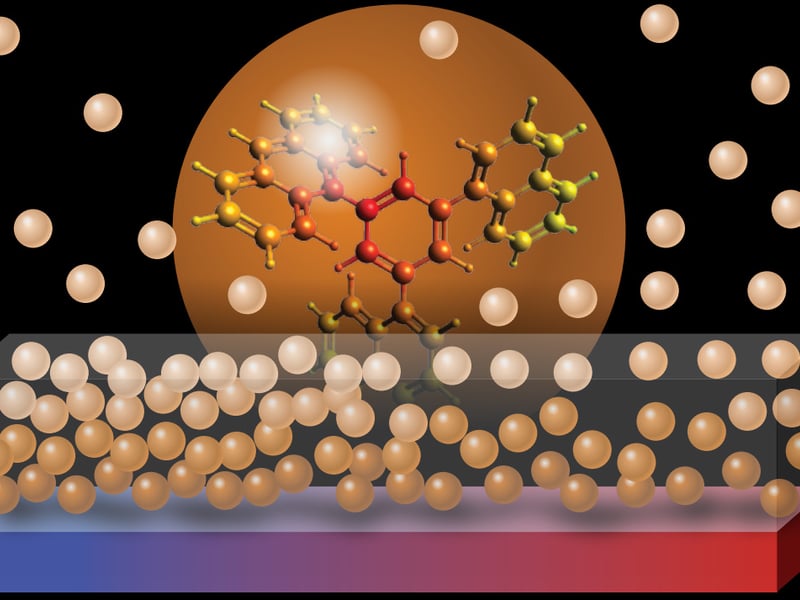
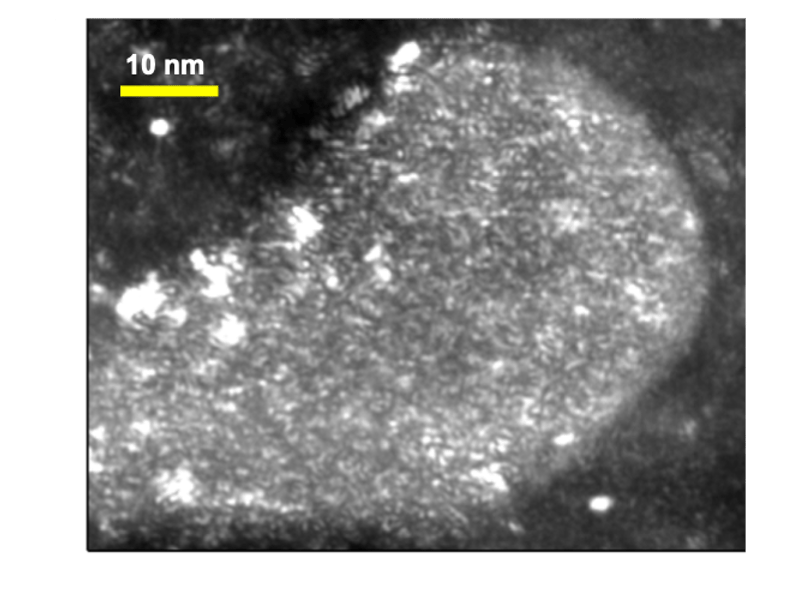
Figure 1: Rabi oscillations of a silicon donor spin-ensemble demonstrate strong coupling and an ideal implementation of the Tavis-Cummings model.
A schematic of the experiment in which a spin polarized STM is used to probe spin signature of Majorana zero mode at the end of the chain.
May 4, 2018
Princeton University

Majorana Spin Diagnostics

Sangjun Jeon 1, Yonglong Xie 1, Jian Li 1, 2, 3, Zhijun Wang 1, B. Andrei Bernevig 1, Ali Yazdani 1 1 Joseph Henry Laboratories and Department of Physics, Princeton University, Princeton, NJ 08544, USA. 2 Institute for Natural Sciences, Westlake Institute for Advanced Study, Hangzhou, Zhejiang, China. 3 Westlake University, Hangzhou, Zhejiang, China.  

The Princeton MRSEC has detected a unique quantum property of an elusive particle, the Majorana fermion that is notable for behaving simultaneously like matter and antimatter. Using enhanced scanning tunneling microscopy techniques, the team captured signals from the Majorana particle at both ends of an atomically thin iron wire stretched on the surface of a crystal of lead.
AMRS participants attend a plenary talk by Nobel Laureate Jean Marie Lehn in Gaborone, Botswana, entitled “Addressing Africa’s Challenges through Materials Development.”
May 4, 2018
Northwestern University

International Conference of the African Materials Research Society

The Northwestern University MRSEC supports a diverse suite of international collaborations and outreach activities. For example, the Center provided support for 10 students and postdoctoral research associates to attend the 9th International Conference of the African Materials Research Society (AMRS) on December 11-14, 2017 in Gaborone, Botswana.
Schematic illustration of the Ultrasound Bioprobe. Customized piezo-transducers underneath the sample and the cantilever provide the flexural vibrations. The atomic force microscope mechanical probe detects the subsurface mechanical contrast.
May 4, 2018
Northwestern University

Facilities Development: Combined Ultrasonic and Scanning Probe Imaging

In addition to providing access to state-of-the-art commercially available instruments, the Northwestern University MRSEC Shared Facilities also participate in the development of new experimental methods and tools. In particular, the Ultrasound Bioprobe has been developed that combines the noninvasive nature and sensitivity of ultrasound waves with a near-field atomic force microscope mechanical probe that provides high phase sensitivity and mechanical contrast of the scattered ultrasound wave.
Chicago Public School students participate in a discussion of the science and events relevant to Copenhagen before the matinee performance at Northwestern University.
May 4, 2018
Northwestern University

Engineering Transdisciplinary Outreach Program in the Arts (ETOPiA)

Engineering Transdisciplinary Outreach Program in the Arts (ETOPiA) is a Northwestern University MRSEC education and outreach program that uses theater and film media to inspire a cross-disciplinary dialogue about the role of science and technology in society and to highlight some of the ethical and moral implications of scientific and technological progress.
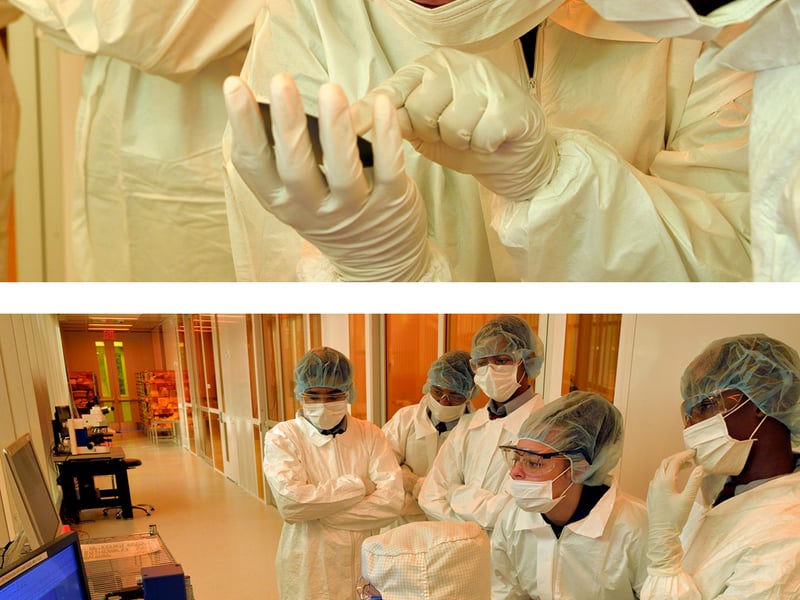
Top: Undergraduate students examine the Hibbard Mummy. Bottom: The Hibbard Mummy is analyzed using Advanced Photon Source synchrotron radiation.
May 4, 2018
Northwestern University

Interrogating Anthropological Mummy Relics with the Tools of Materials Science

The Northwestern University MRSEC supported the new exhibition Paint the Eyes Softer: Mummy Portraits from Roman Egypt at the Northwestern University Block Museum. The exhibit explores the art and science of mummy relics from the Fayum region in Egypt during the Roman period. In a unique interdisciplinary collaboration, the exhibition featured results from an advanced undergraduate seminar, which was co-listed in both the Department of  Materials Science and Engineering and the Department of Classics.
A schematic of the directed evolution pathway that holds promise for accelerating the discovery and design of new materials.
May 4, 2018
Northwestern University

Discovering and Designing New Materials Using Directed Evolution

In a new seed project within the Northwestern University MRSEC, a novel approach for discovering and designing materials is being developed using directed evolution. While directed evolution approaches have been successfully applied in areas such as therapeutics or catalysis, this strategy has not been fully explored in materials science and engineering.
Mixed anion systems such as the oxynitride compound on the left provide a rational pathway toward solid-state spin crossover materials that are inspired by analogous molecular systems such as the example on the right.
May 4, 2018
Northwestern University

Harnessing Mixed Anion Materials for Novel Magnetic Properties

Precise synthetic control of the local electronic structure of metal centers within materials offers the potential to realize exotic physical properties. In particular, tuning the electronic structure of metal centers enables the creation of strongly correlated electron systems, enabling the exploration of fundamental questions about magnetism and superconductivity. In a new seed project within the Northwestern University MRSEC, novel classes of mixed anion materials are being synthesized in an effort to realize new correlated electron properties and related quantum phenomena.
Anion orders compatible with the parent Ruddlesden-Popper structure. From left to right: polar, antipolar layers, and antipolar-in-layer anion order. The gray anions at the octahedral vertices indicate the position of the fluoride ion.
May 4, 2018
Northwestern University

Polyhedral Assembly of Heteroanionic Materials

A route has been formulated that leverages heteroleptic building units to lift inversion symmetry in heteroanionic materials from balancing short-range and long-range interactions favoring octahedral tilting in perovskite-derived structures. The resulting increase in the number of noncentrosymmetric (NCS) materials is important for improving the performance of compounds found in actuator, imaging, and data storage technologies.
Heat map of the convex hull distance of A+B3+OX (X=S, Se, and Te) compounds. Diamond, triangle, pentagon, hexagon, inverted triangle, and square represent P4/nmm, P21/c, Pmc21, Pca21, P21, and other space groups, respectively. The white circle means the compound is unstable.
May 3, 2018
Northwestern University

Computational Discovery of New Oxychalcogenide Compounds

High-throughput density functional theory (DFT) calculations are used to accelerate the discovery of new oxychalcogenide compounds. In particular, experimentally-known crystal structures are decorated with essentially all possible combinations of elements in the periodic table, generating thousands of potential compounds.