Highlights
Jan 16, 2013
University of Minnesota - Twin Cities
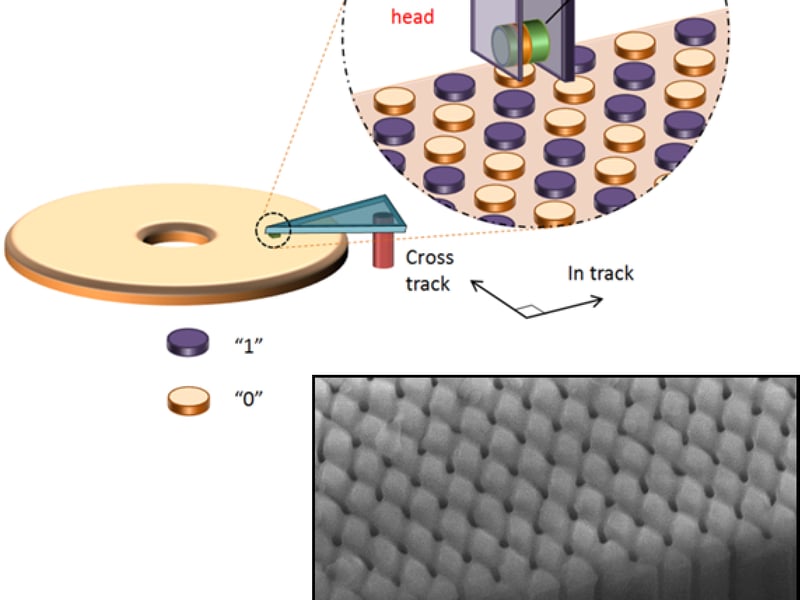
Low Resistivity Magnetic Nano-Sensors
Beth Stadler and Randy Victora (IRG-3)
As electronic devices shrink deep into the nano-scale, low-resistivities become essential.
Dec 18, 2012
University of Utah
NSF MRSEC Takes the Lead in Coaching the Coaches in Materials Science Event
Utah MRSEC provided staff and faculty support for a Science Olympiad coaches’ clinic in November 2012, to help science teachers prepare to coach teams.
37 middle and high school science teachers, 22 of them female, from across the state dedicated their Saturday to attend the clinic to improve Science Olympiad team coaching skills.
Dec 4, 2012
Georgia Institute of Technology
Fabrication on Patterned Silicon Carbide Produces Bandgap for Graphene-Based Electronics
Ed Conrad, Lead Researcher, Georgia Institute of Technology
By fabricating graphene structures atop nanometer-scale “steps” etched into silicon carbide, researchers have for the first time created a substantial electronic bandgap in the material suitable for room-temperature electronics. Use of nanoscale topography to control the properties of graphene could facilitate fabrication of transistors and other devices, potentially opening the door for developing all-carbon integrated circuits.
Nov 28, 2012
Pennsylvania State University
Hidden Roto Symmetries in Nature Discovered
Venkatraman Gopalan (Penn State) and Daniel B. Litvin (Penn State)
NSF MRSEC researchers have discovered a missing spatial operation in nature called rotation-reversal symmetry that reverses the sense of all static rotations in a crystal. Certain minerals, organic crystals or metamaterials are composed of subunits that can exist in two states: clockwise or counter-clockwise rotated. The symmetry of a crystal lattice helps determine the material’s properties, and certain properties can only exist in lattices with special symmetries. In perovskite complex oxides, for example, oxygen cages counter-rotate (see image); these crystals have twice as many
Nov 28, 2012
Pennsylvania State University
Nanoscale Rockets Powered by Ultrasound
Wei Wang (Penn State), Angelica Castro (ESPCI), Mauricio Hoyos (ESPCI), Thomas Mallouk (Penn State)
NSF MRSEC researchers working in an international collaboration with French scientists at ESPCI (Paris Tech) have discovered that rocket-shaped metallic micro-rods can be propelled through fluids using ultrasound, with fast translation towards the tapered end and rapid rotation & assembly of rods into circular chains that move like conveyer belts. Since most ways to make micro-objects move autonomously in fluids are incompatible with biological fluids, this bio-friendly ultrasound technique may be a first step towards the design of powered micro-robots that can perform microsurgery or deliver
Nov 7, 2012
University of Utah
Photochemically Mapping the Near-Fields of Plasmonic Nanocrescents
Objective: Use plasmon-enhanced photochemical reactions to map the polarization-dependent near fields of optical antennas. Approach: Use the anisotropic nano-crescent structure and SU-8 photo-resist. SU-8 exposure accomplished through plasmon-enhanced multi-photon absorption by 800 nm light.
Approach: Use the anisotropic nano-crescent structure and SU-8 photo-resist. SU-8 exposure accomplished through plasmon-enhanced multi-photon absorption by 800 nm light.
Sep 25, 2012
Georgia Institute of Technology
Tracking the Movement of Dopants in an Analog Memristor Using X-Ray Absorption Spectroscopy
Jordan Greenlee, James Compagnoni, Cole Petersburg, Faisal Alamgir, W. Alan Doolittle
Jordan Greenlee, James Compagnoni, Cole Petersburg, Faisal Alamgir, W. Alan Doolittle
1) Department of Electrical and Computer Engineering, Georgia Tech 2) Department of Materials Science and Engineering, Georgia Tech
Sep 25, 2012
Georgia Institute of Technology
International Programs Grow
Edward H. Conrad and Claire Berger
Edward H. Conrad and Claire Berger
School of Physics, Georgia Institute of Technology
Sep 25, 2012
Georgia Institute of Technology
Fibroblast Cell Adhesion on Dynamic Microgel Substrates
Hiroaki Yoshida, Jeffrey Gaulding, Apoorva Kalasuramath, Andrés J. García, L. Andrew Lyon
Hiroaki Yoshida, Jeffrey Gaulding, Apoorva Kalasuramath, Andrés J. García, L. Andrew Lyon School of Chemistry and Biochemistry, Petit Institute for Bioengineering and Bioscience, Woodruff School of Mechanical Engineering, Georgia Institute of Technology
Sep 19, 2012
Georgia Institute of Technology
An Electron's Life on the Edge
David B. Torrance, Baiqan Zhang, Tien Hoang and Phillip N. First
David B. Torrance, Baiqan Zhang, Tien Hoang and Phillip N. First School of Physics, Georgia Tech
Showing 901 to 910 of 1452