Highlights

May 7, 2018
Center for Emergent Materials (2014)

Physics of Emergent Materials Workshop (POEM)

R. Page and  J. Katoch, Ohio State University

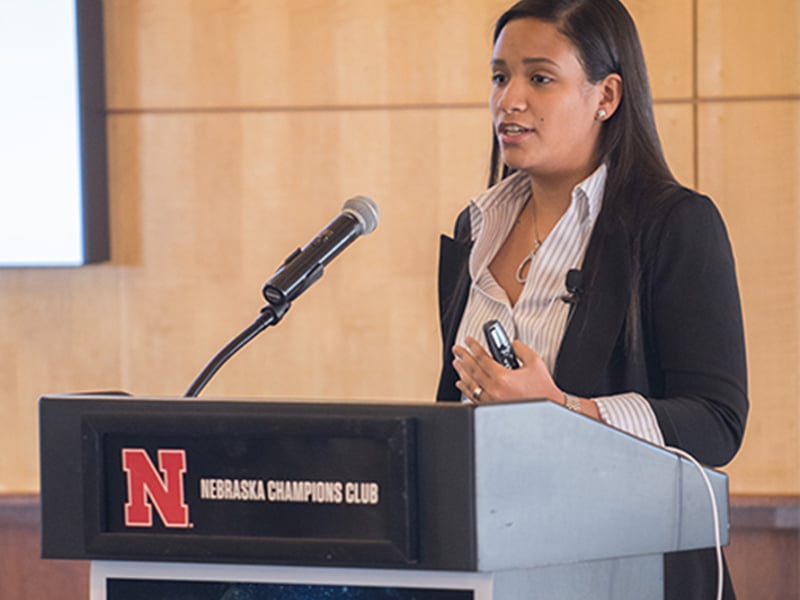
The CEM Internal Advisory Council, a grassroots committee of students and postdoctoral researchers, created POEM to inform the Center’s direction and improve the educational and research experiences of CEM students. 
May 7, 2018
CU Boulder Soft Materials Research Center (2014)

Nanoparticles For Delivery of DNA Therapeutics

A. Harguindey1, D.W. Domaille1, B.D. Fairbanks1, J. Wagner1, C.N. Bowman1,2, J.N. Cha1,2   1 Chemical and Biological Engineering - University of Colorado, Boulder, CO 80309, USA. 2 Materials Science and Engineering Program - University of Colorado, Boulder, CO 80309, USA.

Many advanced drugs acting in cells are made of DNA fragments.  Since DNA is biologically active and destroyed if not recognized, a major challenge for this kind of medicine is getting the DNA into selected target cells.  SMRC researchers have found that soap-like molecules that form nanometer-size spherical particles in water and that have a DNA-like component as part of their molecular structure can act as effective carriers of therapeutic DNA for cancer treatment.
Figure 1: Rabi oscillations of a silicon donor spin-ensemble demonstrate strong coupling and an ideal implementation of the Tavis-Cummings model.
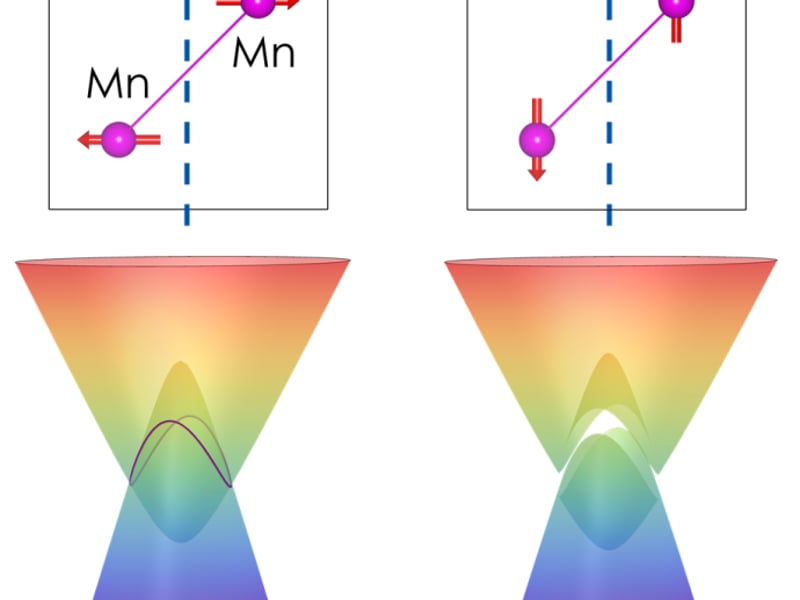
A schematic of the experiment in which a spin polarized STM is used to probe spin signature of Majorana zero mode at the end of the chain.
May 4, 2018
Princeton Center for Complex Materials (2014)

Majorana Spin Diagnostics

Sangjun Jeon 1, Yonglong Xie 1, Jian Li 1, 2, 3, Zhijun Wang 1, B. Andrei Bernevig 1, Ali Yazdani 1 1 Joseph Henry Laboratories and Department of Physics, Princeton University, Princeton, NJ 08544, USA. 2 Institute for Natural Sciences, Westlake Institute for Advanced Study, Hangzhou, Zhejiang, China. 3 Westlake University, Hangzhou, Zhejiang, China.  

The Princeton MRSEC has detected a unique quantum property of an elusive particle, the Majorana fermion that is notable for behaving simultaneously like matter and antimatter. Using enhanced scanning tunneling microscopy techniques, the team captured signals from the Majorana particle at both ends of an atomically thin iron wire stretched on the surface of a crystal of lead.
AMRS participants attend a plenary talk by Nobel Laureate Jean Marie Lehn in Gaborone, Botswana, entitled “Addressing Africa’s Challenges through Materials Development.”
May 4, 2018
Northwestern Materials Research Science and Engineering Center

International Conference of the African Materials Research Society

The Northwestern University MRSEC supports a diverse suite of international collaborations and outreach activities. For example, the Center provided support for 10 students and postdoctoral research associates to attend the 9th International Conference of the African Materials Research Society (AMRS) on December 11-14, 2017 in Gaborone, Botswana.
Schematic illustration of the Ultrasound Bioprobe. Customized piezo-transducers underneath the sample and the cantilever provide the flexural vibrations. The atomic force microscope mechanical probe detects the subsurface mechanical contrast.
May 4, 2018
Northwestern Materials Research Science and Engineering Center

Facilities Development: Combined Ultrasonic and Scanning Probe Imaging

In addition to providing access to state-of-the-art commercially available instruments, the Northwestern University MRSEC Shared Facilities also participate in the development of new experimental methods and tools. In particular, the Ultrasound Bioprobe has been developed that combines the noninvasive nature and sensitivity of ultrasound waves with a near-field atomic force microscope mechanical probe that provides high phase sensitivity and mechanical contrast of the scattered ultrasound wave.
Chicago Public School students participate in a discussion of the science and events relevant to Copenhagen before the matinee performance at Northwestern University.
May 4, 2018
Northwestern Materials Research Science and Engineering Center

Engineering Transdisciplinary Outreach Program in the Arts (ETOPiA)

Engineering Transdisciplinary Outreach Program in the Arts (ETOPiA) is a Northwestern University MRSEC education and outreach program that uses theater and film media to inspire a cross-disciplinary dialogue about the role of science and technology in society and to highlight some of the ethical and moral implications of scientific and technological progress.
Top: Undergraduate students examine the Hibbard Mummy. Bottom: The Hibbard Mummy is analyzed using Advanced Photon Source synchrotron radiation.
May 4, 2018
Northwestern Materials Research Science and Engineering Center

Interrogating Anthropological Mummy Relics with the Tools of Materials Science

The Northwestern University MRSEC supported the new exhibition Paint the Eyes Softer: Mummy Portraits from Roman Egypt at the Northwestern University Block Museum. The exhibit explores the art and science of mummy relics from the Fayum region in Egypt during the Roman period.