Highlights

May 14, 2010
NYU Materials Research Science and Engineering Center (2014)

NYU MRSEC Highlight: Education and Outreach

Nearly 500 K-12 students from NYC schools visited NYU MRSEC laboratories for science demonstrations as part of the MRSEC Scientific Frontiers Program Developed class modules for 70 9th graders in the Urban Assembly Institute for Math and Science for Young Women, an all-girls school in Brooklyn for the underrepresented and underprivileged Science demonstrations, in Spanish, for more than 80 students at Don Pedro Albizu Campos elementary school, which primarily serves economically disadvantaged Hispanic student
May 14, 2010
NYU Materials Research Science and Engineering Center (2014)

NYU MRSEC Seed Highlight: A Photon Driven Nano-lander orbiting a Micro-moon

S. Arnold

 Whispering Gallery Mode Carousel: Forces exerted by an evanescent light wave at the surface of a spherical glass resonator draw microscopic colloidal particles toward the resonator surface  Intensity of the red-shifted light provides an exponentially sensitive probe of the particle-resonator separation; wavelength probes the strength of the light-matter interaction Virus-sized nanoparticle (a.k.a. “nano-lander”) in orbit about a glass microsphere (a.k.a. “micro-moon) under the influence of light that generates a radial tractor beam and a tangential photon wind
May 14, 2010
The Georgia Tech Laboratory for New Electronic Materials (2008)

Ultrafast Relaxation of Hot Dirac Fermions in Epitaxial Graphene

Dong Sun, Zong-Kwei Wu, Charles Divin and Theodore Norris Center for Ultrafast Optical Science, University of Michigan Xuebin Li, Claire Berger, W. A. de Heer, and P. N. First, School of Physics, Georgia Institute of Technology

In high speed devices, electrons are accelerated to high energy by a high electric field; to understand device performance, it is important to know how those “hot” electrons relax by scattering with each other and with the environment (the graphene lattice and the SiC substrate).
May 5, 2010

Wind Tunnel Applications for Middle School Math & Science

Timothy Newbold, RET Teacher Researcher, The Gordon School Research Advisors: Janet Blume, PhD. Brown University, 2009

The list of potential curricular connections and activities that can be done with a wind tunnel in middle school is almost endless. This project incorporates simple geometry, weather, lab skills, metric measurement, as well as having the students work through the design process and actually construct and test their creations. The project bridges math and science wonderfully with real world applications that the students can get excited about and really understand. The interactive approach of this project can not help but enhance a student’s learning.
May 5, 2010

Understanding the Mechanisms Controlling Sn Whisker Formation

E. Chason, A.F. Bower,, S. Kumar, N. Jadhav, and E. Buchovecky, Division of Engineering, Brown University

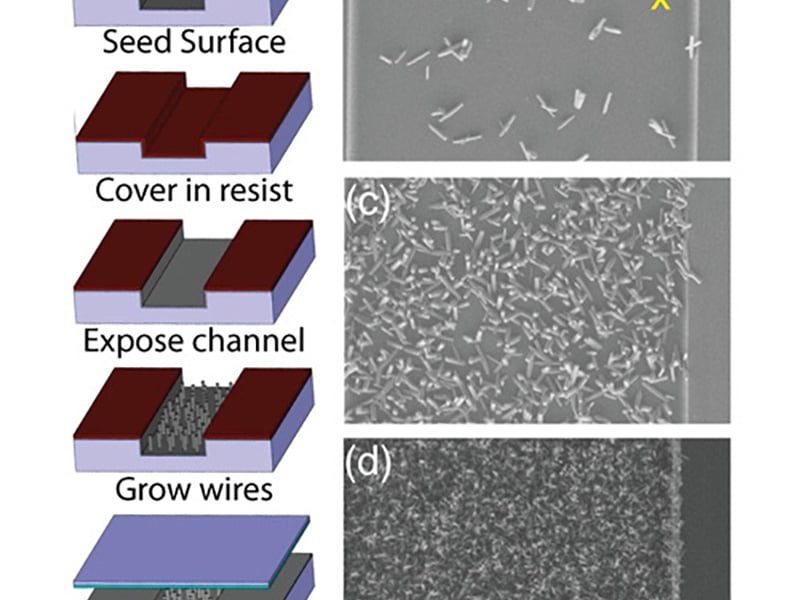
Sn whiskers are a serious reliability problem in Pb-free electronics manufacturing.  Whiskers (as in fig. 1) grow out of pure Sn coatings and have been responsible for numerous system failures, such as the Galaxy IV satellite. To increase our understanding of whisker growth, we have performed systematic measurements to quantify the whisker growth kinetics and the correlation between the formation of a Sn-Cu intermetallic compound (IMC), stress in the Sn and whisker nucleation.
May 5, 2010

Edges-stress induced warping and rippling of graphene

B. Shenoy, Division of Engineering, Brown University

 Graphene, an atomic layer of carbon atoms arranged in a honeycomb lattice, is actively being pursued as a material for next-generation electronics because of the high mobility of charge carriers and the potential to control their density by applying a gate voltage.
Apr 19, 2010
Materials Research Science and Engineering Center at UCSB

High school students learn about alternative energy at UCSB MRSEC workshop

Educational Outreach

Dozens of excited middle and high school students from across Santa Barbara County spent a morning learning about alternative energy by building and racing their own solar cars. The workshop, presented as part of Science and Technology Day at UCSB, included a presentation on alternative energy, hands-on activities, and a corresponding video for teachers. This workshop was developed by graduate students in collaboration with education staff from the UCSB Materials Research Laboratory.
Apr 19, 2010
Materials Research Science and Engineering Center at UCSB

Materials Research Facilities Network (MRFN) Virtual Instrumentation Partnership (VIP)

A. A. Odukale, C. J. Hawker

Initiative provides access to analytical instrumentation instruction to Minority Serving and Primarily Undergraduate Institutions through 4 types of virtual experiences:  1) User institution selects technique and class can access manuals, laboratories, and view training videos at http://www.mrfn.org 2) Live sessions through Skype featuring MRFN scientist explaining theory and manipulating instruments 3) Real time sample analysis in which students dictate instrument parameters and 4) Real time question and answer dialogue featuri
Apr 19, 2010
Materials Research Science and Engineering Center at UCSB

Understanding Nature’s glue

Herb Waite, Matt Tirrell and Jacob Israelachvili

Mussel-inspired adhesion has much to teach about the chemistry and processing of polymers and provides a glimpse of some remarkable physical properties exhibited by this complex fluid. . Mussel adhesive processing has been mimicked by Waite, Tirrell and Israelachvili mixing a recombinant mussel adhesive protein (MAP) with hyaluronic acid (HA) to form a fluid coacervate. Significantly, these unique materials were shown to be shear-thinning,