Outcomes: Penn MRSEC researchers Stebe and Lee developed a 3D-printable ink that, after extrusion, spontaneously phase-separates into a bicontinuous oil-water emulsion stabilized by fumed silica nanoparticles, locking in two interpenetrating channels with sub-micron domains while the printed object holds an arbitrary centimeter-scale shape.
Impacts and Benefits: Bicontinuous gels offer the unusual combination of independent transport through two interpenetrating channels and a huge interfacial area between them, but until now they could be made only in simple shapes (fibers, films, droplets). Combining direct ink writing with phase separation makes macroscale geometry and sub-micron microstructure independently programmable, with direct applications in biomedical implants, tissue scaffolding, biphasic reactors, separation membranes, radiative-cooling coatings, and electrodes for energy storage.
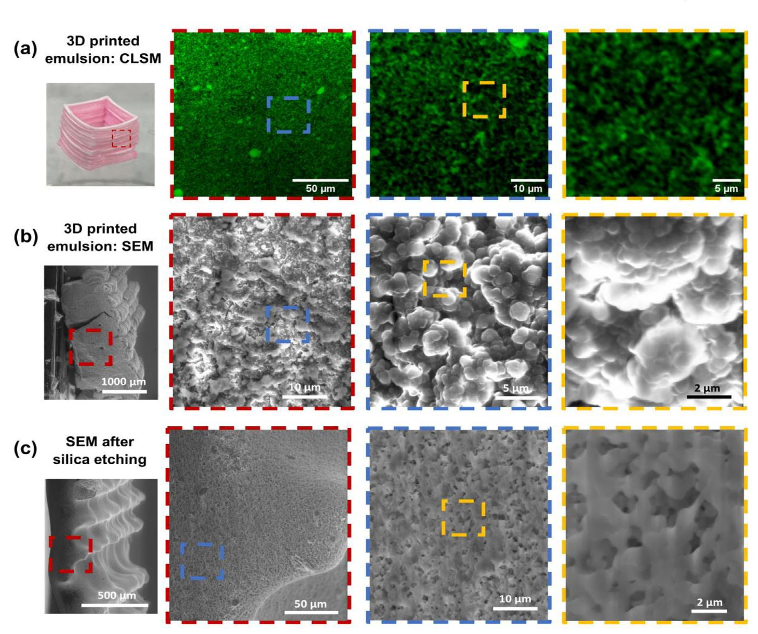
Explanation: Bicontinuous emulsion gels are mixtures of two immiscible liquids whose phases form interpenetrating networks rather than discrete droplets. Standard routes (thermal quenches, solvent-transfer phase separation) constrain the macroscopic shape to the container or fiber geometry. The team designed a one-phase ternary ink — oil monomer, water, ethanol co-solvent, plus hydrophilic and hydrophobic fumed silica — whose silica content thickens it for direct ink writing while keeping it single-phase. After extrusion the ethanol evaporates into the surrounding air, driving the ink across its spinodal line and phase-separating it into a bicontinuous oil-water structure on the order of tens of seconds. Silica nanoparticles jam at the oil-water interface as it forms and simultaneously gel the bulk of each phase. UV curing locks the oil as a polymer skeleton; drying removes the water and yields a hierarchical porous material.
 Download
3D Printing of Bicontinuous Nanoparticle‐Stabilized Emulsion Gels via Co‐Solvent Removal

UPENN Materials Research Science and Engineering Centers
The LRSM at UPENN is a center of excellence for materials research and education. It facilitates collaboration between researchers from different disciplines including physics, chemistry, engineering, and biology to advance transformative scientific projects and solve societal challenges.