Outcomes: Penn MRSEC researchers Good, Chenoweth, and Patel designed short disordered peptides that assemble into stable, gel-phase coacervate particles, loaded them with proteins of interest, and delivered them into living cells without any gene transfer, where the particles act as designer biochemical compartments that capture and degrade native target proteins.
Impacts and Benefits: Existing routes to synthetic membraneless organelles require viral or nanoparticle-mediated gene delivery, which is slow, indirect, and difficult to control. Ex vivo fabrication followed by direct uptake removes that bottleneck and produces a tunable, one-pot platform for installing biochemical activity inside cells, with immediate applications in cell engineering, regenerative medicine, and targeted protein degradation as a therapeutic modality.
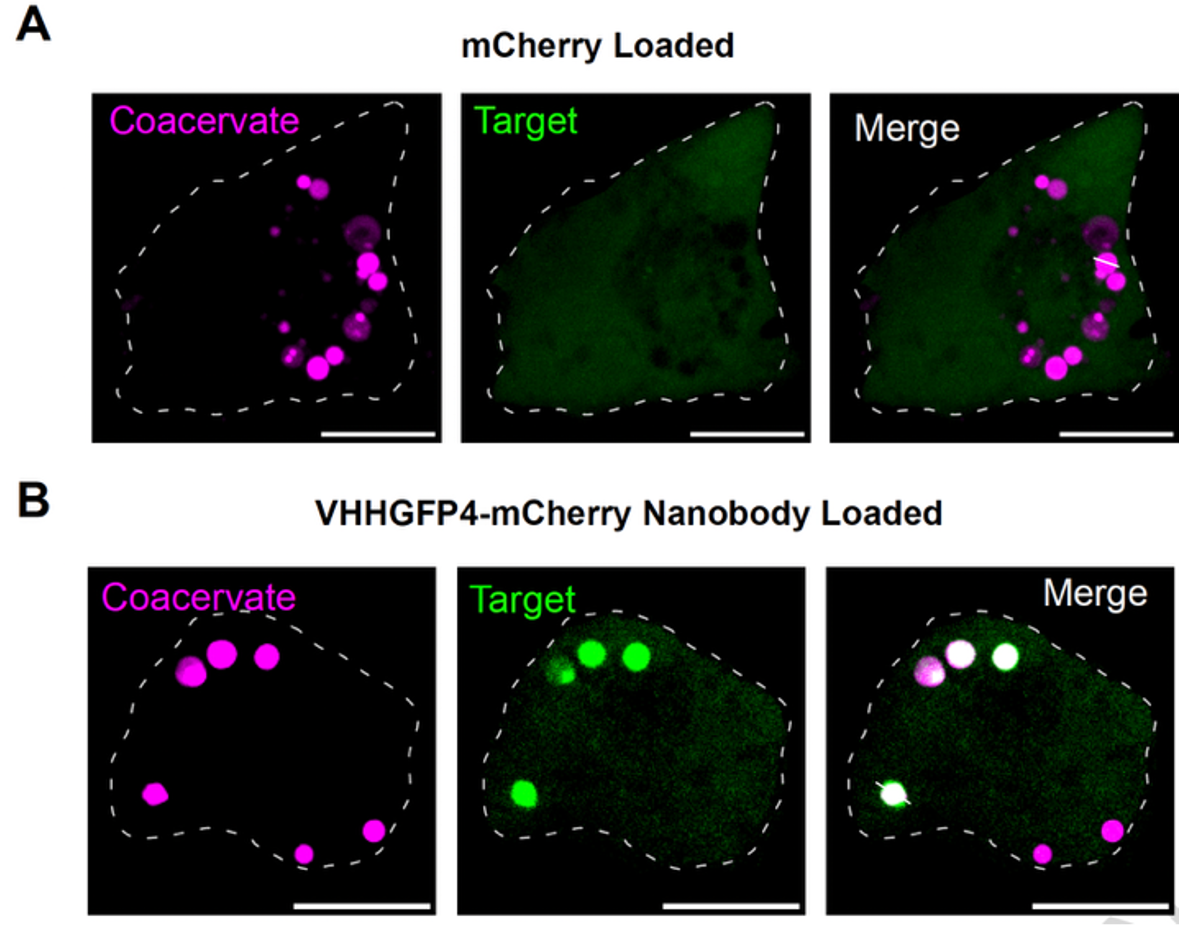
Explanation: Short tyrosine-rich peptides (HBpep, HBpep-SA) phase-separate via pH or temperature shift into 1–5 µm gel-phase coacervate particles, confirmed gel-like by slow FRAP recovery. A 25-amino-acid HBP partition tag fused to a cargo protein boosted loading and dictated whether cargo distributed through the bulk or sat at the particle surface. The loaded coacervates crossed the plasma membrane of U2OS, B16-F10 murine melanoma, and primary human monocyte cells and persisted in the cytosol for days. Particles carrying the VHHGFP4 nanobody captured a model GFP target at the particle surface (synthetic interaction hubs); particles carrying a bioPROTAC (the nanobody fused to the SPOP167-374 E3 ligase adaptor) reduced cytosolic GFP by 78% within one day, with target recruitment, ubiquitylation, and proteasomal clearance handled by the delivered particles.
 Download
Delivery of peptide coacervates to form stable interaction hubs in cells

UPENN Materials Research Science and Engineering Centers
The LRSM at UPENN is a center of excellence for materials research and education. It facilitates collaboration between researchers from different disciplines including physics, chemistry, engineering, and biology to advance transformative scientific projects and solve societal challenges.