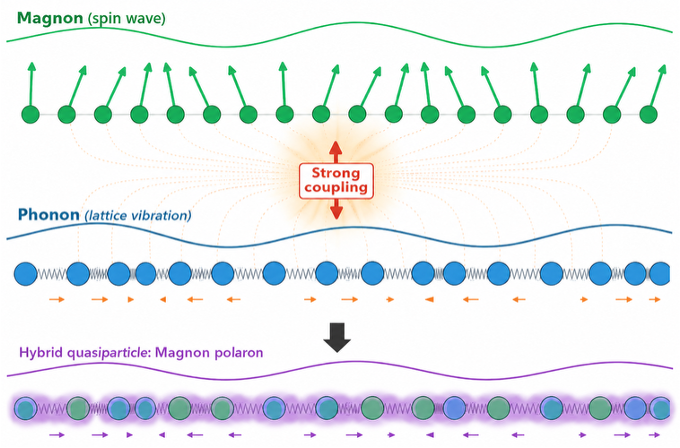
Spin waves called magnons are an emerging way to carry information with far less energy than today’s electronics and to link qubits in future quantum technologies. How long that information survives is limited by the spin waves’ coupling to atomic vibrations, especially at room temperature.
Wisconsin MRSEC IRG 2 researchers have developed an efficient, accurate first-principles computational method that predicts how magnons and atomic vibrations (phonons) couple inside magnetic materials — a calculation that previously required prohibitively expensive computations. By predicting this coupling from the chemical composition of a material alone, with no fitted parameters, the new method lets researchers screen and design materials with longer-lasting, higher performing spin waves before any sample is grown.
IRG 2 will use this method in their ongoings research to control magnon-phonon coupling using strain, chemical doping, and terahertz light.
 Download
Efficient method for calculating magnon-phonon coupling from first principles

Wisconsin Materials Research Science and Engineering Center
The U.S. National Science Foundation-sponsored Wisconsin Materials Research Science and Engineering Center brings together teams of researchers from diverse disciplinary backgrounds to tackle grand challenges in the materials science of liquids and glasses and non-equilibrium magnetism.