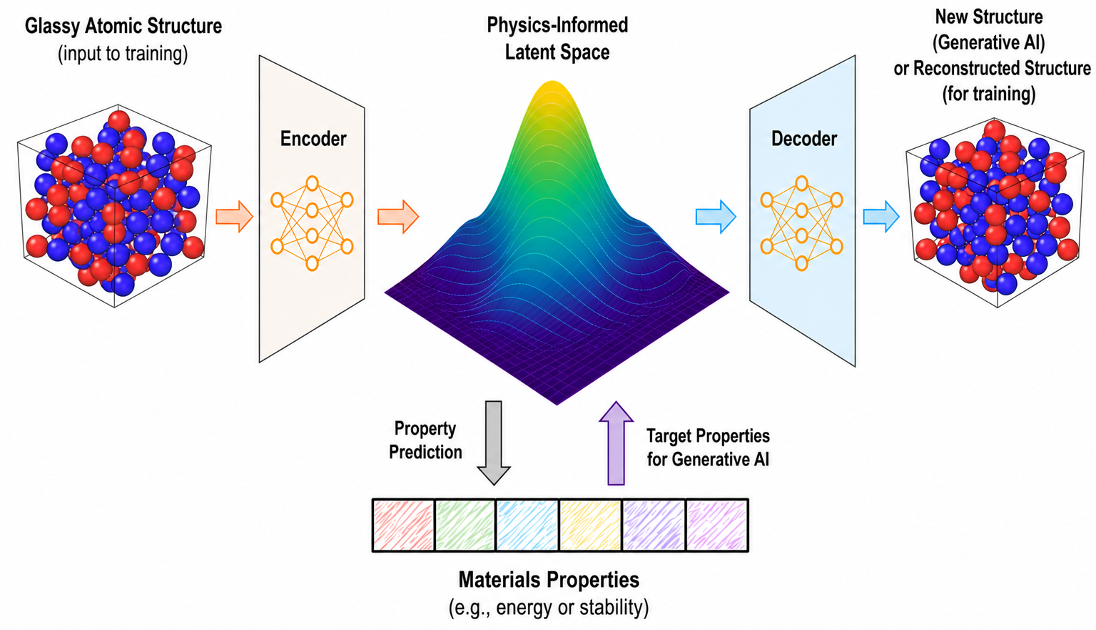
Wisconsin MRSEC IRG 1 developed a new generative AI model for metallic glasses, called GlassVAE. The model is based on ideas similar to ChatGPT, but adapted to describe the complex atomic structures of glasses. It is designed to recognize meaningful changes in atomic structure, rather than being affected by how atoms are positioned or labeled in traditional coordinate descriptions. Unlike many general-purpose AI models that often generate unrealistic atomic arrangements, GlassVAE includes “physics guardrails” based on structural features and energy, ensuring that the generated structures remain physically sensible.
A key outcome of this work is a simplified “map” of possible structures for a given glass composition, known as a latent space. The map captures how energy or stability varies with structure. Researchers can explore the map to generate new structures with desired properties and study how atoms rearrange over time, helping reveal how glasses evolve and respond under different conditions.
 Download
Physical-regularized Hierarchical Generative Model for Metallic Glass Structural Generation and Energy Prediction

Wisconsin Materials Research Science and Engineering Center
The U.S. National Science Foundation-sponsored Wisconsin Materials Research Science and Engineering Center brings together teams of researchers from diverse disciplinary backgrounds to tackle grand challenges in the materials science of liquids and glasses and non-equilibrium magnetism.