What has been achieved:
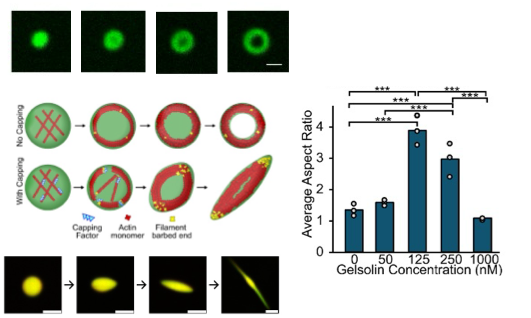
We have demonstrated that assembly of actin filaments inside protein condensates creates distinct material architectures. When filaments are allowed to grow freely, the resulting long, flexible actin filaments form a ring-like coil within condensates, which deforms condensates into toroidal architectures. In contrast, when a filament capping or severing protein is introduced to limit filament length, the resulting collection of shorter filaments assembles into rigid bundles that deform condensates into rods of high aspect ratio.
Importance of Achievement:
Alignment of semi-rigid actin filaments to form bundles is a key step toward creating rigid structural elements that can withstand and apply tunable mechanical forces in actin-based materials. This work shows that we can transform the architecture of the actin network from a “trapped” toroidal architecture to a “functional” rod-like architecture through the addition of filament capping and severing proteins. This capability could be used to achieve dynamic control materials that generate unidirectional forces.
Walker, et al., Sci. Adv. in print.
 Download

Center for Dynamics and Control of Materials
This NSF MRSEC brings together researchers from across science and engineering to create materials with new atomic-scale structures and functionalities, and to develop approaches for actively controlling and reconfiguring materials in real time.