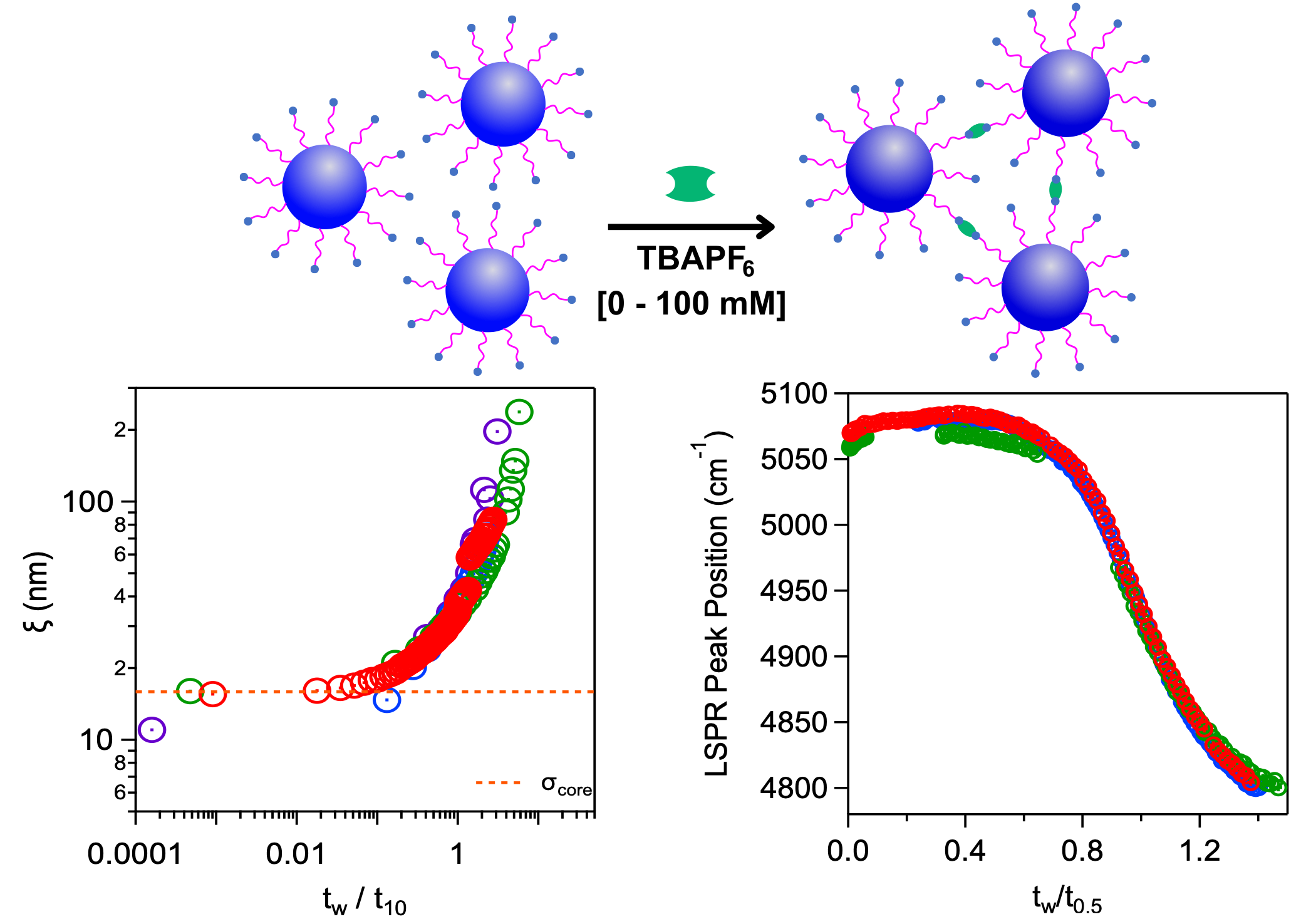
We have achieved temporally programmable gelation of aldehyde-functionalized tin-doped indium oxide nanocrystals linked with bifunctional hydrazide linkers. The addition of tetrabutylammonium hexafluorophosphate salt accelerates assembly, enabling systematic control over gel kinetics. In situ measurements using small-angle X-ray scattering, X-ray photon correlation spectroscopy, Vis-NIR spectroscopy, and kinetic Monte Carlo simulations reveal a time-salt superposition of structural, dynamical, and optical trajectories throughout gelation.
This achievement is important because it enables kinetic tunability of dynamic colloidal assemblies without requiring synthetic redesign or sacrificing targeted functionality. This advance contributes to the goals of the Center for Dynamics and Control of Materials at UT Austin, which aims to develop novel material control strategies. Controlling the assembly kinetics of a chemically fueled gel, where the concentration of bifunctional linkers or competing molecules are dynamically varied, will further unlock pathways toward temporal programming of material properties.
 Download
Universal progression of structure and dynamics in colloidal nanocrystal gels during salt-accelerated aging

Center for Dynamics and Control of Materials
This NSF MRSEC brings together researchers from across science and engineering to create materials with new atomic-scale structures and functionalities, and to develop approaches for actively controlling and reconfiguring materials in real time.