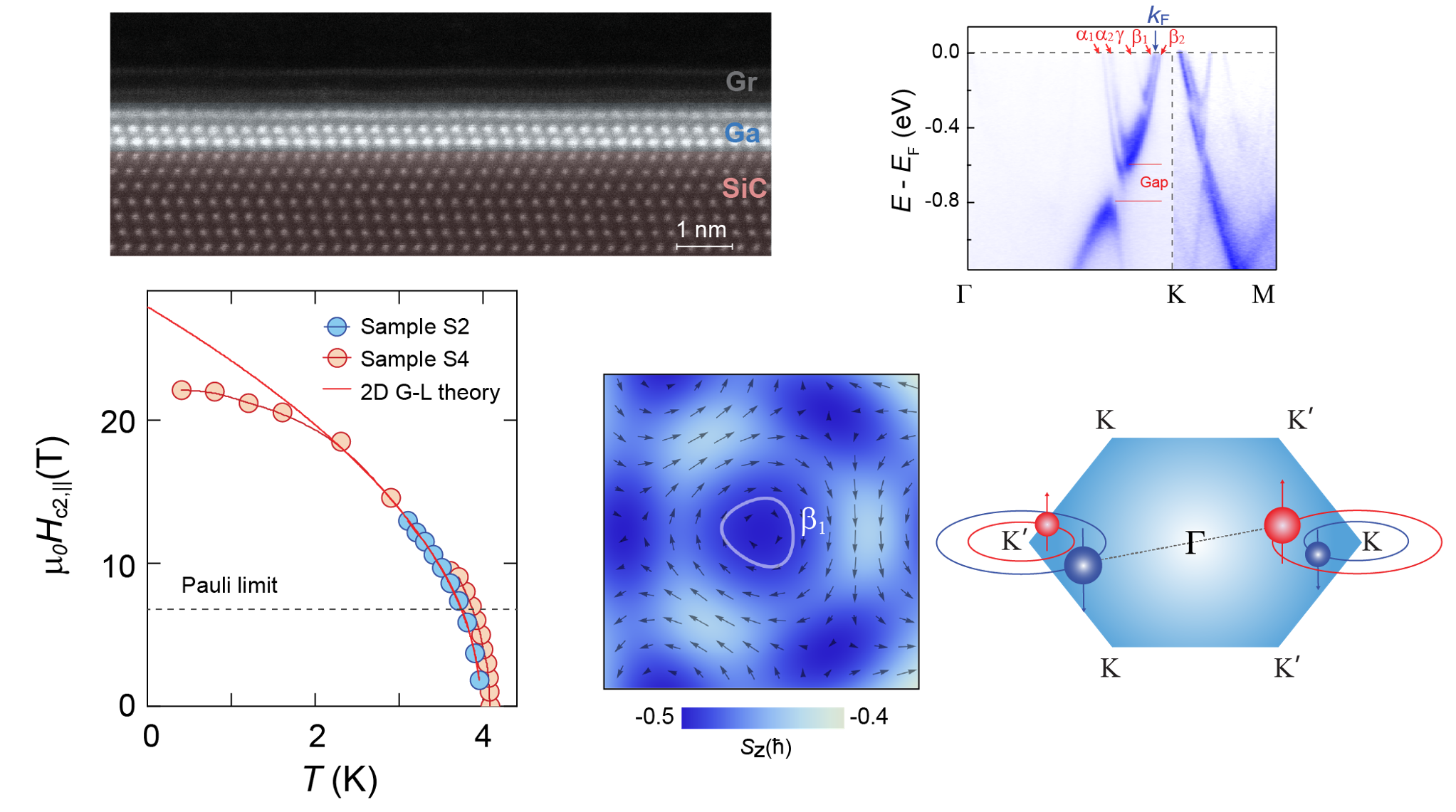
The coupling between an electron’s orbital motion and its spin can give rise to unconventional superconducting states where the pairing between the electrons that creates the superconductivity has an Ising-like character, meaning that the spins are “locked” to be perpendicular to the 2D layer.
These effects were generally thought to occur only in elements of high atomic number, where the spin-orbit effect is stronger. The IRG team has used a unique means of material synthesis to create extremely high quality 2D layers of the light element gallium that are stable in the air, enabling detailed measurements that reveal unconventional Ising superconductivity. The in-plane upper critical magnetic field exceeds the Pauli paramagnetic limit by more than a factor of three, a key sign of Ising superconductivity.
Through a combination of ARPES measurements and first-principles calculations, the team identified split Fermi surfaces at the K and K’ valleys with strong Ising-type spin textures, enabled by interfacial atomic orbital hybridization between the Ga layer and the Si layer of the SiC substrate.
 Download
Orbital-hybridization-induced Ising-type superconductivity in a confined gallium layer
Penn State Center for Nanoscale Science (2020)
The Center for Nanoscale Science supports collaborative, interdisciplinary research efforts on nanoscale materials. Principal research activities are organized into two interdisciplinary research groups: 2D Polar Metals & Heterostructures and Crystalline Oxides with High Entropy. Center-initiated programs encourage collaborative partnerships with science museums and non-R1 universities as well as engagement in outreach, education, and workforce development initiatives.