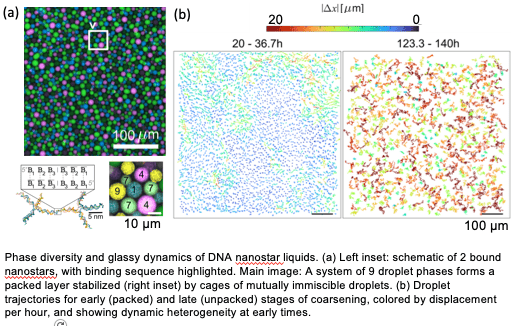
In this work the diverse liquid biomolecular phases were studied that can be encoded by combinatorial variation of the sequence of DNA ‘nanostar’ particles. The work established theoretical limits on nanostar phase diversity, and experimentally showed the ability to create nine distinct, non-adhering nanostar phases that do not share components.
This nine-phase system can create packed 2-D droplet layers that are kinetically stabilized specifically by the mutual immiscibility of the many phases. This layer displayed glassy dynamics, such as slow coarsening and dynamic heterogeneity.
This work provides a new benchmark of achievable multi-phase diversity, as well as demonstrating the novel types of materials that can be engineered by exploiting that diversity. The system they demonstrate will lead to behaviors with new mechanical behaviors and has high potential for creating spatially organized droplet reactors that mimic living tissue.
 Download
Diverse, distinct, and densely packed DNA nanostar droplets

Materials Research Science and Engineering Center at UCSB
The NSF Materials Research Science and Engineering Center at UC Santa Barbara develops and sustains a productive, collaborative, and engaged community that drives a portfolio of transformative materials research and empowers a diverse workforce.