Compensated ferrimagnets combine the advantages of ferromagnets and antiferromagnets: near-zero net magnetization reduces stray fields and enables fast, stable operation, while large exchange splitting allows a finite anomalous Hall effect (AHE) for electrical readout. In crystalline kagomé materials, nontrivial band structure and Berry curvature further enable strong intrinsic AHE, making them attractive for spintronic applications.
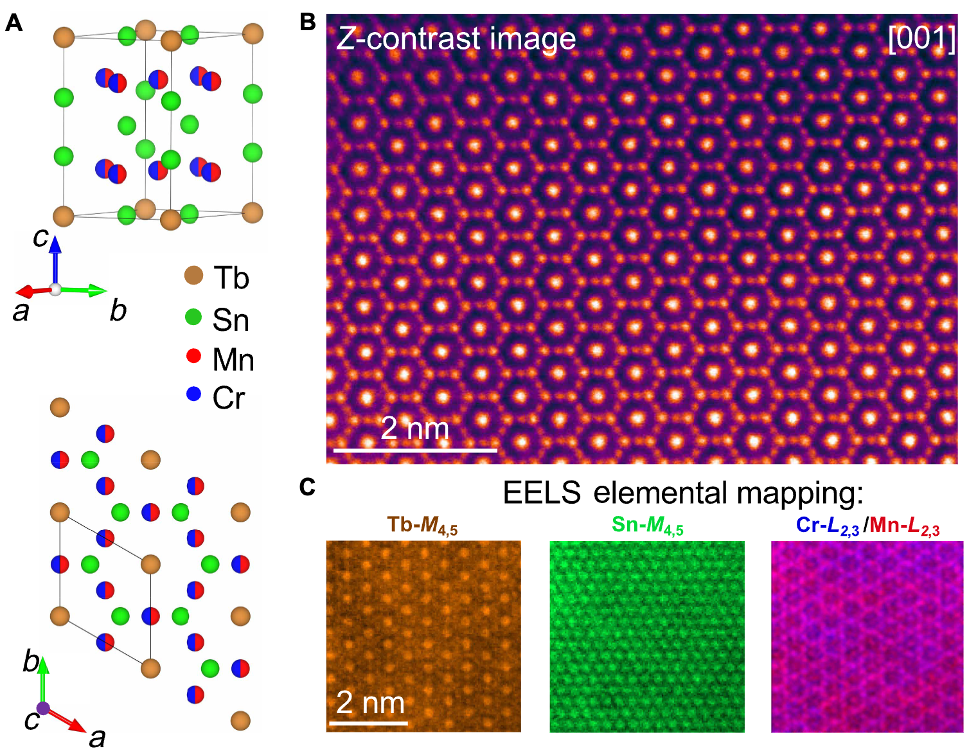
We demonstrate that chemical doping can systematically tune compensated ferrimagnetism in the kagomé compound Tb(Mn₁₋ₓCrₓ)₆Sn₆. By substituting Cr for Mn, we drive the system toward magnetic compensation, achieving giant coercive fields (>14 T) near compensation and significantly enhancing the intrinsic AHE through Fermi level tuning. This work establishes doping as a practical route to control magnetic compensation and optimize functional transport properties in kagomé ferrimagnets.
 Download
Giant coercivity and enhanced intrinsic anomalous Hall effect at vanishing magnetization in a compensated kagome ferrimagnet

University of Washington Molecular Engineering Materials Center
The University of Washington Molecular Engineering Materials Center, an NSF MRSEC, executes fundamental materials research that aims to push the frontiers of science and accelerate the emergence of future advanced technologies.