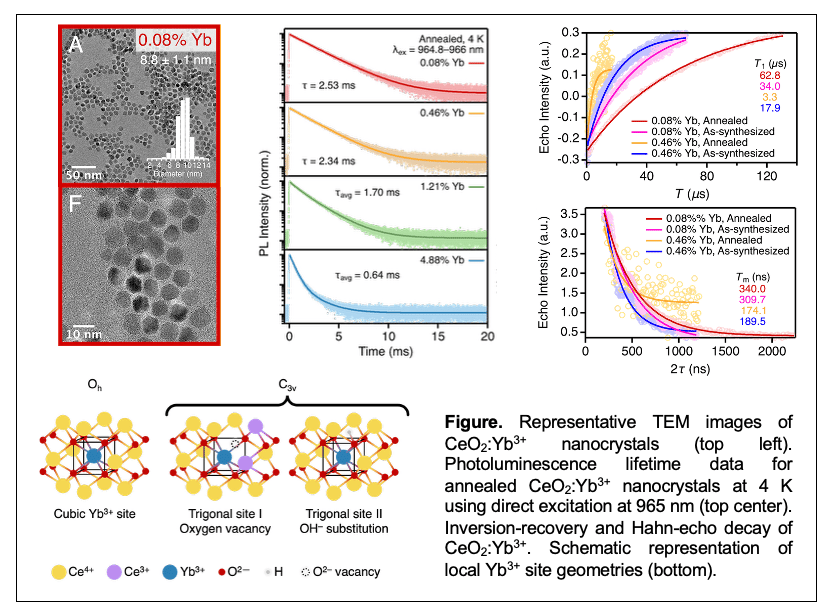
Controlling defects in wide‑bandgap nanomaterials is central to building scalable quantum systems. In this work, we demonstrated optically active and spin-bearing Yb3+ defects in CeO2 nanocrystals, establishing quantitative benchmarks for excited‑state optical lifetimes, spin‑lattice relaxation (T1), and spin coherence (Tm). We identified two distinct Yb3+ lattice sites with ~5× lifetime differences, and we directly linked these to local defect environments. We showed that annealing at 700 °C reduces Ce3+and oxygen‑vacancy defects, nearly doubling the T1 spin lifetime and improving optical lifetimes.
This work establishes defect mitigation as the key bottleneck for realizing rare‑earth spin qubits in colloidal nanocrystal hosts and establishes CeO2:Yb3+ nanocrystals as a platform for future IRG efforts in rare‑earth qubits. It directly supports the IRG mission to integrate synthesis, defect engineering, and quantum characterization to create next‑generation spin-photon interfaces based on nanocrystals. It demonstrates the power of MEM-C-enabled collaboration (synthetic chemistry + spectroscopy + EPR) to uncover structure-property relationships essential for scalable quantum technologies.
 Download
Optically Active Yb3+ Spin Defects in Cerium Oxide Nanocrystals

University of Washington Molecular Engineering Materials Center
The University of Washington Molecular Engineering Materials Center, an NSF MRSEC, executes fundamental materials research that aims to push the frontiers of science and accelerate the emergence of future advanced technologies.