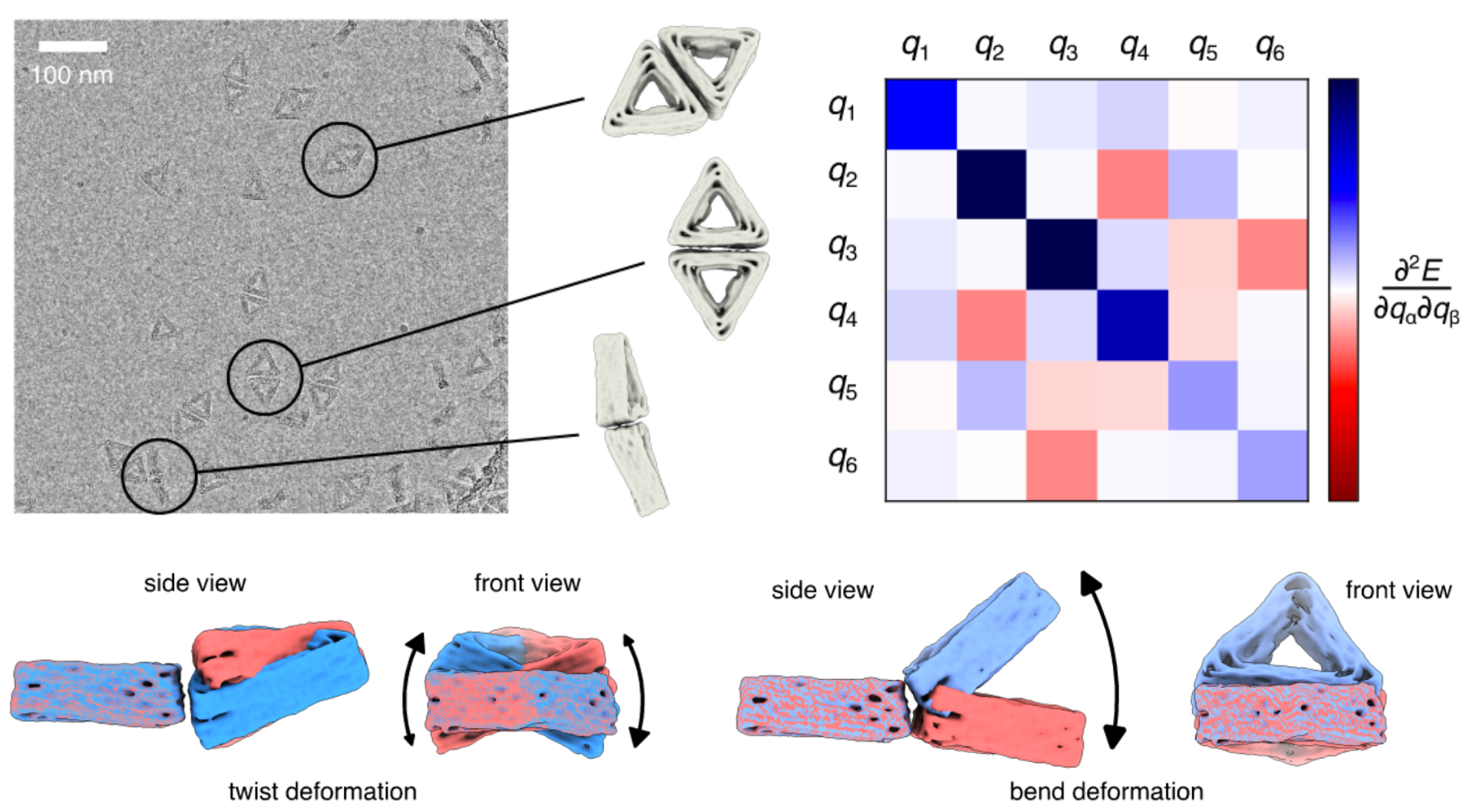
Going beyond the self-assembly of static structures necessitates the design, measurement, and control of the local flexibility of the building blocks as well as their assemblies. In this study, Rogers, Fraden,Grason, and Hagan demonstrated a method to infer the mechanical properties of multisubunitassemblies using cryogenic electron microscopy (cryo-EM). Specifically, Rogers analyzed the fluctuations of pairs of DNA-origami subunits that self-assemble into self-closing tubules, from which they extracted mechanical properties such as the bending modulus and interparticle spring constant. These properties were then applied to elastic models by Hagan and Grason to predict assembly outcomes, which aligned well with experimental observations. This methodology could have broader applications in the study of nanomaterials, including protein assemblies, where understanding the interplay of mechanical properties and subunit geometry is essential for controlling complex self-assembled structures.
 Download
Measuring multisubunit mechanics of geometrically programmed colloidal assemblies via cryo-EM multi-body refinement
.png/thumbcontain)
The Bioinspired Soft Materials Center (2020)
The Brandeis Materials Research Science and Engineering Center (MRSEC) seeks to create new materials that are constructed from only a few simplified components, yet capture the remarkable functionalities found in living organisms.