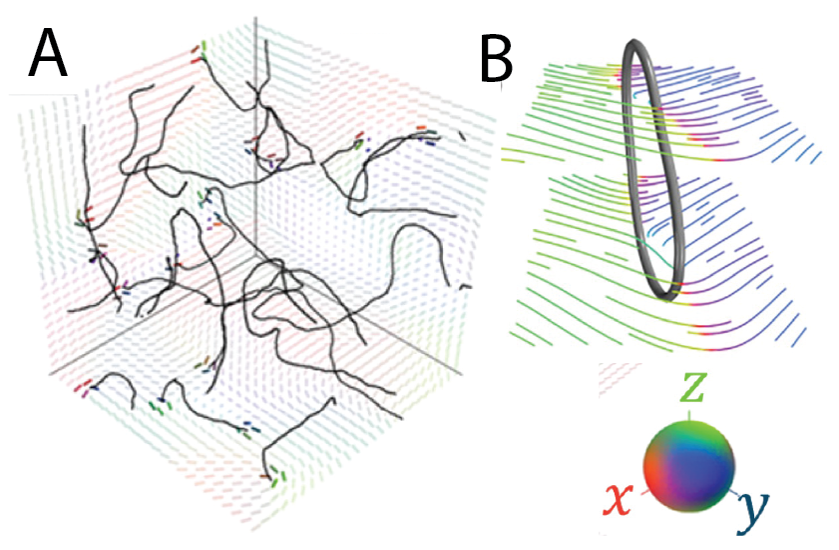
One specific objective of IRG2 is to design novel composite materials where both active and passive stresses are tunable by dispersing active building blocks in diverse passive soft materials. Here, Baskaran and Hagan performed simulations of 3D active nematics, inspired by experiments in which active polymers were dispersed in a passive colloidal liquid crystal by Duclos and Dogic. This paper introduce a new framework to study The nucleation of topological defects in 3D active nematics. They show that defect morphology depends on an effective stiffness that is modulated by activity. This achievement is important because it establishes a unified picture of topological defects in 3D active nematics and provides design principles for controlling defect-driven dynamics in materials with liquid crystalline order, which is one of the main objectives of the IRG.
 Download
Mechanics of disclination emergence in three-dimensional active nematics
.png/thumbcontain)
The Bioinspired Soft Materials Center (2020)
The Brandeis Materials Research Science and Engineering Center (MRSEC) seeks to create new materials that are constructed from only a few simplified components, yet capture the remarkable functionalities found in living organisms.