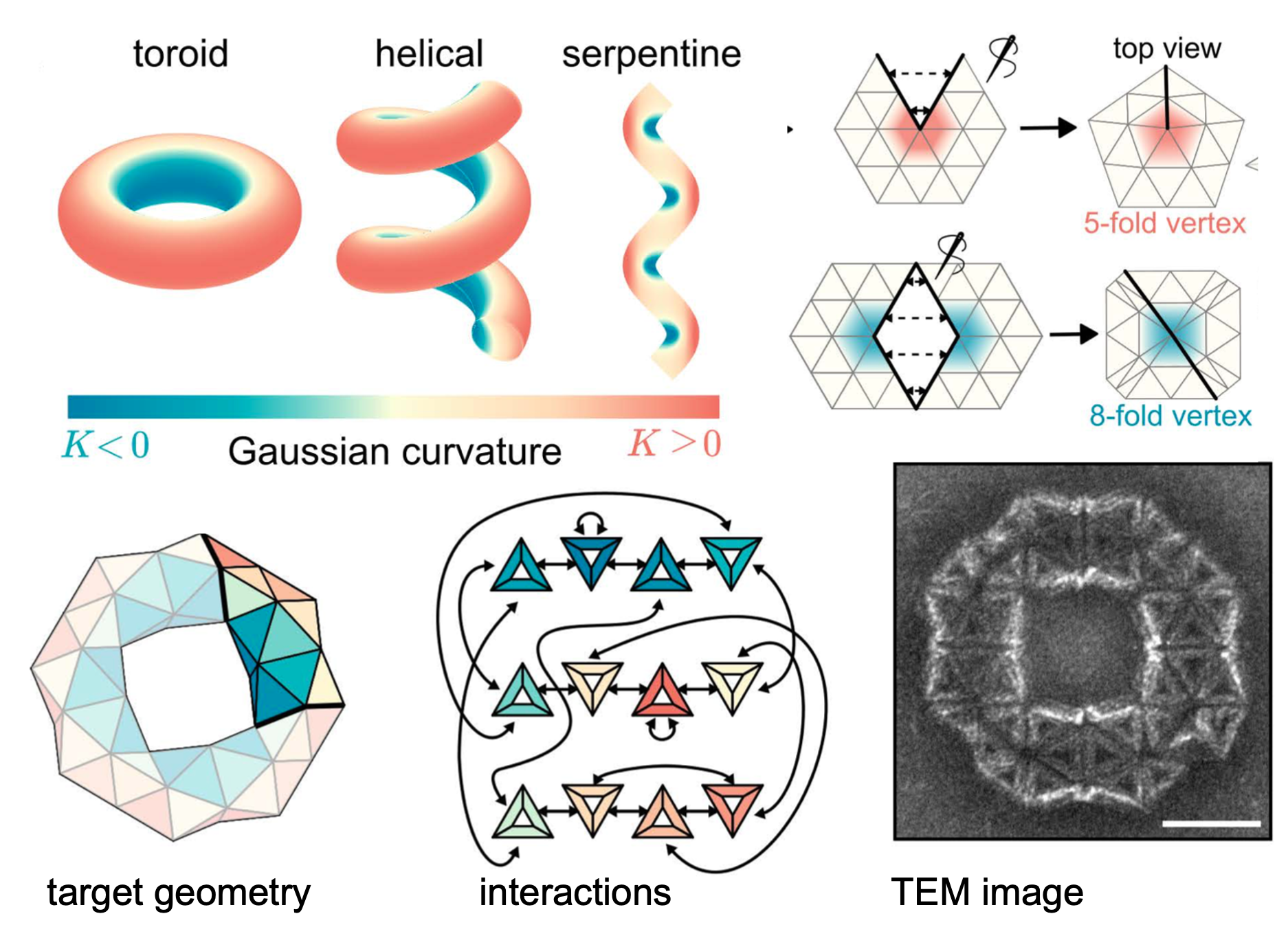
A goal of IRG1 is to create economical design principles to target families of curved tubules with prescribed bend and writhe. In this study, Rogers, Fraden, Grason, and Hagan developed and implemented a design strategy to program the self-assembly of a complex spectrum of two-periodic curved crystals with variable periodicity, spatial dimension, and topology, spanning from toroids to achiral serpentine tubules to both left- and right-handed helical tubules. Their design strategy exploited a kirigami-based mapping of a modular class of 2D planar tilings to 3D curved crystals that preserved the periodicity, two-fold rotational symmetries, and subunit dimensions by modulating the arrangement of disclination defects. To demonstrate their designs practice, Rogers programed the self-assembly of toroids, helical, and serpentine tubules from DNA origami subunits. A simulation model of assembly by Hagan and Grason revealed physical considerations for avoiding defect-mediated misassembly.
 Download
From toroids to helical tubules: Kirigami-inspired programmable assembly of two-periodic curved crystals from DNA origami
.png/thumbcontain)
The Bioinspired Soft Materials Center (2020)
The Brandeis Materials Research Science and Engineering Center (MRSEC) seeks to create new materials that are constructed from only a few simplified components, yet capture the remarkable functionalities found in living organisms.