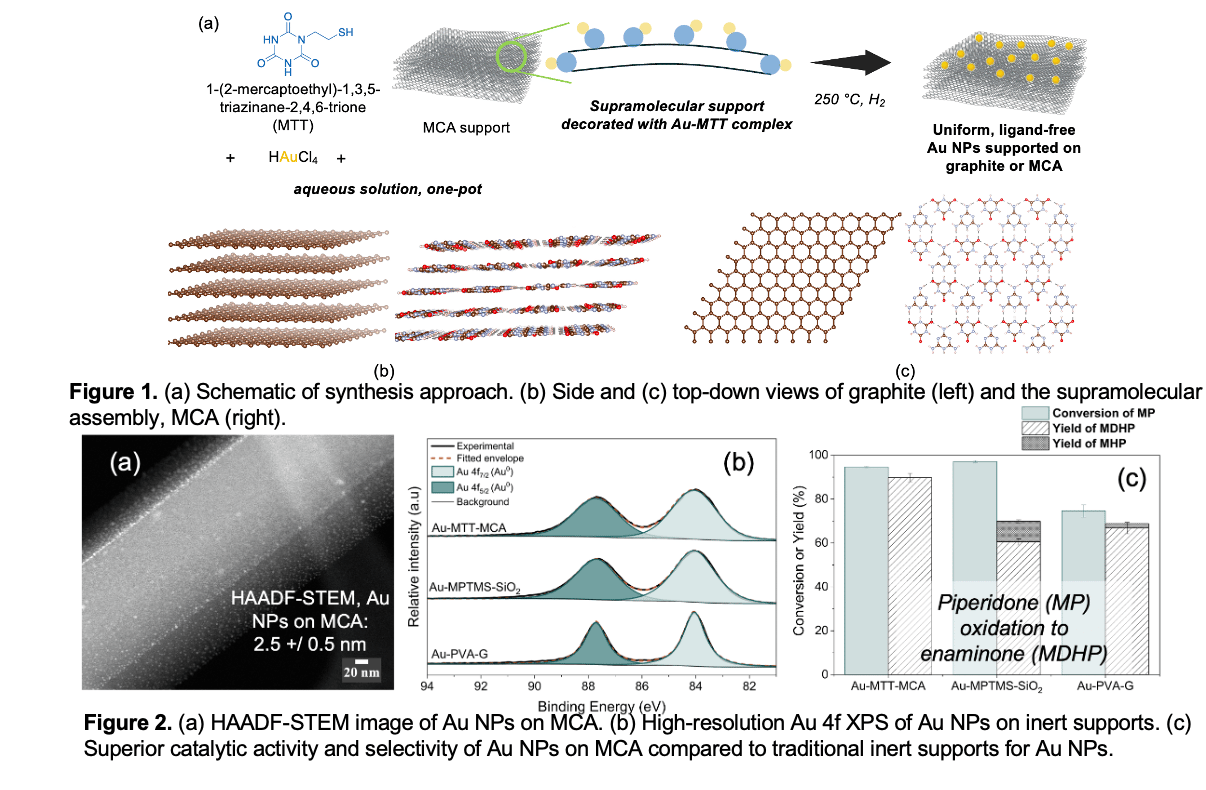
What has been achieved? We designed a new synthetic approach to preparing supported metal nanoparticle (NP) catalysts based on a noncovalent assembly, melamine cyanurate (MCA). We leverage molecular recognition between the support and a thiol-functionalized triazinane derivative (MTT, Fig. 1a) for high dispersion of metal (Au, Pt) precursors onto the MCA support. Mild thermal treatment yields metallic (M0) NPs with size uniformity matching that of colloidal methods, but without requiring any surface ligands (Fig. 2a, 2b).
Why is this achievement important? MCA has catalytically similar properties to traditional supports (e.g., graphite), but affords molecular-level tunability due to its supramolecular nature. This has practical impact in the context of designing catalysts with high selectivity without sacrificing activity (Fig. 2c), and also enables fundamental studies on bare NP surfaces that have been traditionally obscured by confounding support and/or ligand effects.
How is the achievement related to the IRG/MRSEC, and how does it help it achieve its goals? The synthetic method designed here introduces a fundamentally new class of supramolecular materials as a versatile platform for catalyst design with great potential in diverse electro/photo/thermal catalytic routes.
Notes: The work accomplishments noted here are described in full in a paper currently under review (Bahl, Po, Bukowski, Lusardi) and one that is in preparation (same authors).
 Download

Princeton Center for Complex Materials (2020)
Established in 1994, the Princeton Center for Complex Materials is dedicated to exploring the frontiers of complexity in materials science. The Center supports two IRGs that will accelerate exploration of quantum technologies and biology-inspired materials.