Motivation: Proteins, and their shorter ‘cousins’ peptides, are the building blocks of life, providing dynamic structures and functions from the molecular to the macro-scale in living systems. Yet, creating stable, designed materials with them remains a challenge.
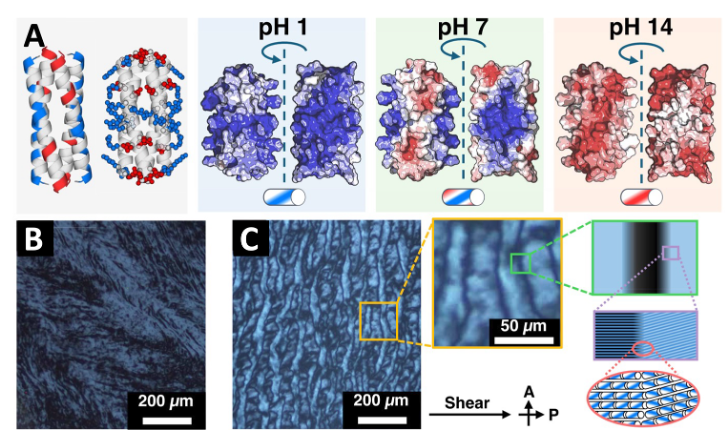
Achievements: We designed peptide ‘patchy particles’ with patterned surface charge to program ordered, stable materials across a broad pH range (1-14). At low pH, liquid crystals formed with different phases at low concentrations of building block (nematic) versus higher concentrations (hexagonal columnar).
Importance: This work shows how charges are arranged on a peptide particle surface, not just its composition, governs how it assembles for the predictable control of biomolecular assemblies across extreme conditions.
MRSEC relevance: This contribution advances the design of responsive, hierarchical biomaterials through collaborative team science: a versatile platform for making soft materials that function under harsh conditions with protein-like specificity and control and future opportunities for use as nano-actuators to do work.
 Download
Patchy peptide particles for pH-responsive assembly into liquid crystals or lattices

Center for Hybrid, Active, and Responsive Materials (2020)
UD CHARM advances foundational understanding of new materials driven by theoretical and computational predictions paired with cutting-edge experiments to enable the integration of unconventional, ultra-small, building blocks.