Research in IRG-1 in the UMN MRSEC has brought oxide electrochemical transistors to the verge of applications. Cycling endurance and switching speed are the two final roadblocks to realistic devices. Last year, a major, record-breaking advance was made with cycling endurance. This year, a record-breaking advance with switching speed has been made.
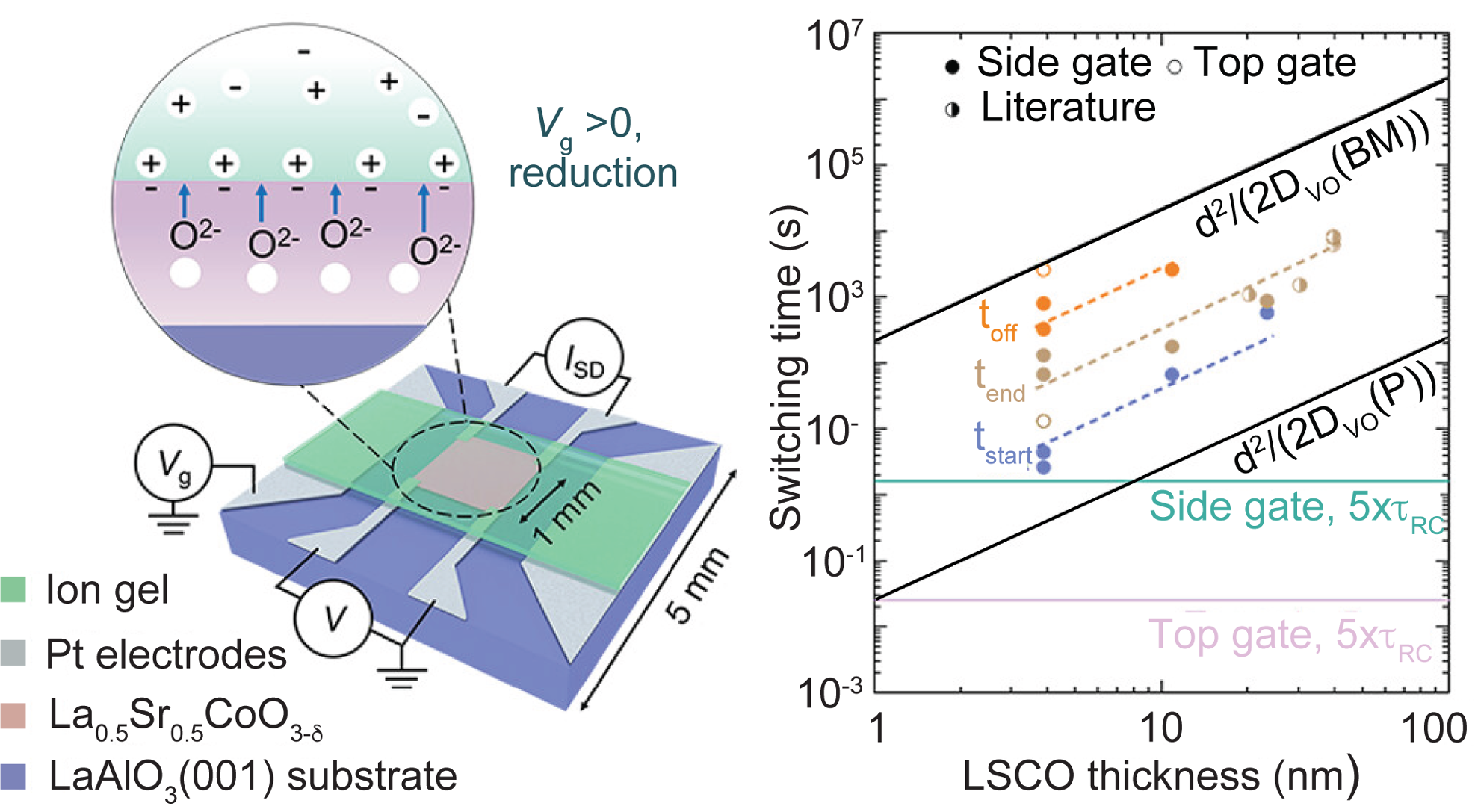
IRG-1 researchers probed the limits on transformation speed in electrochemical transistors based on La0.5Sr0.5CoO3-d (LSCO), a premier material for such devices. With an applied voltage, LSCO’s oxygen content is controlled, triggering a topotactic structural transformation, with accompanying modulation of electronic, optical, and magnetic properties. The IRG-1 team established for the first time that oxygen diffusion in the oxide is the rate-limiting process, insight that enabled orders-of-magnitude improvement in switching speed, to sub-1-second response times. Routes to further gains were also unveiled and are currently under study in the UMN MRSEC.
 Download
Limits on Topotactic Transformation Speed in Electrolyte-Gate La0.5Sr0.5CoO3-δ Electrochemical Transistors
UMN Materials Research Science and Engineering Center (2020)
This multifaceted NSF MRSEC enables important areas of future technology, ranging from applications of electrical control over materials to scale-invariant shape-filling amphiphile network self-assembly. The UMN MRSEC manages an extensive program in education and career development. The MRSEC is bolstered by a broad complement of over 20 companies that contribute directly to IRG research through intellectual, technological, and financial support. International research collaborations and student exchanges are pursued with leading research labs in Asia and Europe.