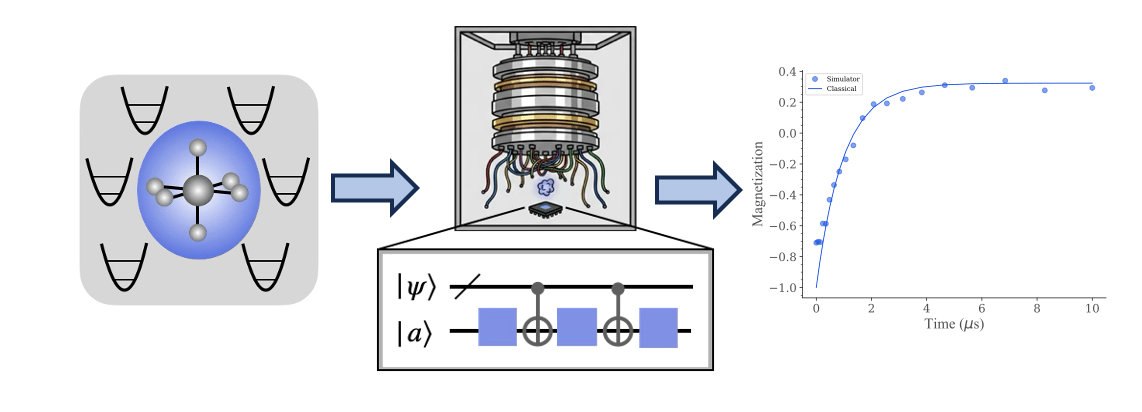
Research in this Seed has resulted in important methods to theoretically predict decoherence, or information loss, in quantum systems that could function as quantum computers or quantum sensors. The project developed algorithms for practical implementation on current noisy-intermediate scale quantum computers. The first focused on modelling temperature-dependent relaxation in single-molecule magnets with demonstrations of efficacy on IonQ’s Aria-1 trapped-ion quantum processor. The second focused on modelling parity-time symmetric dynamics, suggested to be useful in quantum computing and quantum sensing, with demonstrations on IBM’s quantum devices. One of the primary challenges faced by these algorithms is the presence of noise in the quantum hardware. To this end, research in this Seed also considered optimal state-preparation protocols to prepare and control useful quantum states in qubits when noise and dissipation are present. These three advances were published in the three papers noted to the right.
K. Aydoğan, M. Abbasi, W.J. Short, M.Z. Fahrenbruch, T.J. Krogmeier, A.W. Schlimgen, K. Head-Marsden, Digital Discovery, 2026, 5, 1228. doi.org/10.1039/D5DD00405E
M. Abbasi, K. Aydoğan, A.W. Schlimgen, K. Head-Marsden, Phys. Rev. Res., 2026, 8, 013034. doi.org/10.1103/gwbz-mbfw
K. Aydoğan, A.W. Schlimgen, K. Head-Marsden, Phys. Rev. Res. 2025, 7, 023057. doi.org/10.1103/PhysRevResearch.7.023057
 Download
UMN Materials Research Science and Engineering Center (2020)
This multifaceted NSF MRSEC enables important areas of future technology, ranging from applications of electrical control over materials to scale-invariant shape-filling amphiphile network self-assembly. The UMN MRSEC manages an extensive program in education and career development. The MRSEC is bolstered by a broad complement of over 20 companies that contribute directly to IRG research through intellectual, technological, and financial support. International research collaborations and student exchanges are pursued with leading research labs in Asia and Europe.