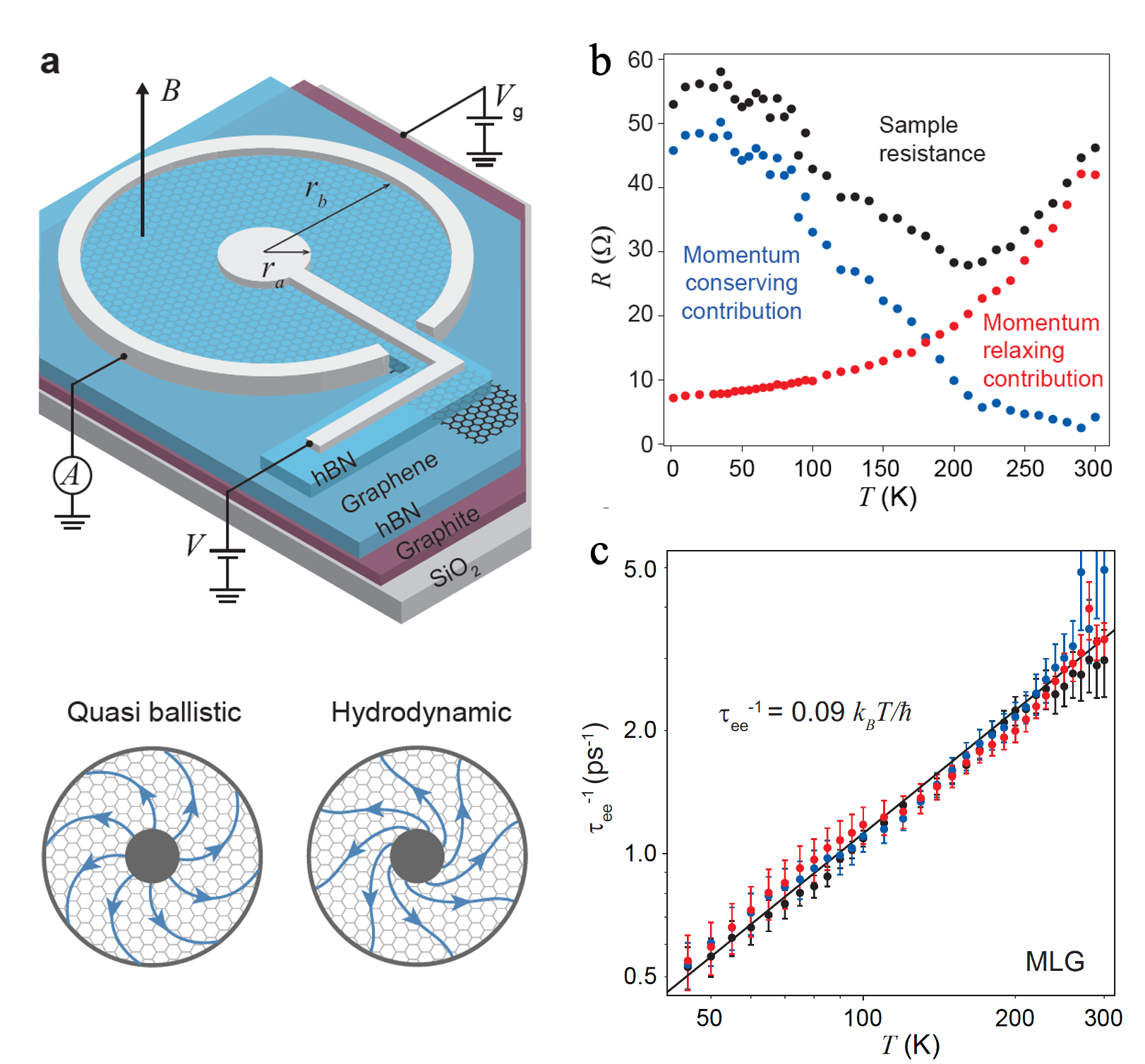
Electron hydrodynamics, in which the motion of electrons are viewed analogous to the flow of a viscous fluid, has emerged as a powerful framework to understand transport behavior of systems with strong electron-electron interactions. Relating theory to experiment however has proven a challenge owing to the difficult to measure the electron-electron scattering time. IRG1 demonstrated for the first time that magnetoresistance in a Corbino geometry provides a combined ohmmeter/viscometer allowing both dissipative and momentum conserving electron scattering to be disentangled and quantified in a single device. Applying this technique to study the hydrodynamic flow regime in graphene the team makes the surprising discovery that electron-electron scattering rate scales linearly with temperature, which is unexpected in standard theory but consistent with a recently predicted tomographic fluid regime. IRG1 further demonstrates that in the low density limit the system crosses over to a nearly perfect Dirac fluid with viscosity parameter approaching a theoretical quantum limit.
 Download
Center for Precision Assembled Quantum Materials (PAQM) (2020)
PAQM encompasses two IRGs that build higher dimensional materials from lower dimensional structures to create the next generation of quantum, optoelectronic, and energy transport materials.