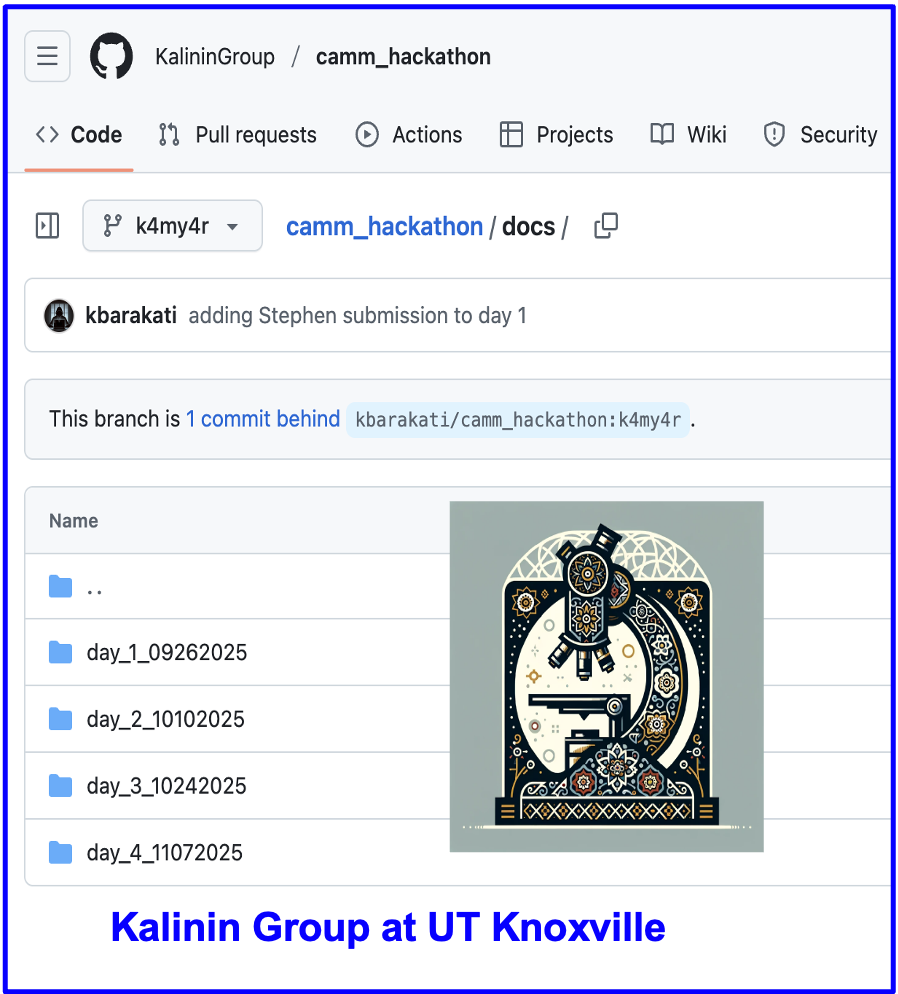
The Center for Advanced Materials & Manufacturing (CAMM) launched a biweekly “Machine Learning for Materials Discovery” Hackathon, bringing together students and researchers from materials science, physics, and data science to explore how AI can accelerate materials design. Over 5 intensive sessions since October 2025, participants worked through hands-on problems that linked real experimental data to modern machine learning workflows.
Full-stack ML for materials: teams moved from property-prediction regression (linear → ensembles → neural nets) to interpretable structure–property insights.
From images to decision-ready descriptors: built feature-engineering pipelines for microscopy/spectroscopy that enable multi-objective optimization of materials performance.
Explainability + causality: combined SHAP-style interpretation with causal reasoning to identify how structure, chemistry, and processing drive thermal and mechanical behavior.
Physics-informed diffraction workflows: applied deep kernel learning + Bayesian optimization to XRD to extract lattice parameters, strain, and microstructural evolution.
Culture shift: collaborative debugging and strategy sharing reinforced ML as a quantitative extension of physical intuition, directly supporting CAMM’s workforce mission.
 Download