Organic semiconductors are key materials for electronic displays, organic electronics, and other technologies. How the component molecules fit together to make the material is critical to how it conducts electricity and emits and absorbs light. Often, well-ordered, straight molecular packing is beneficial.
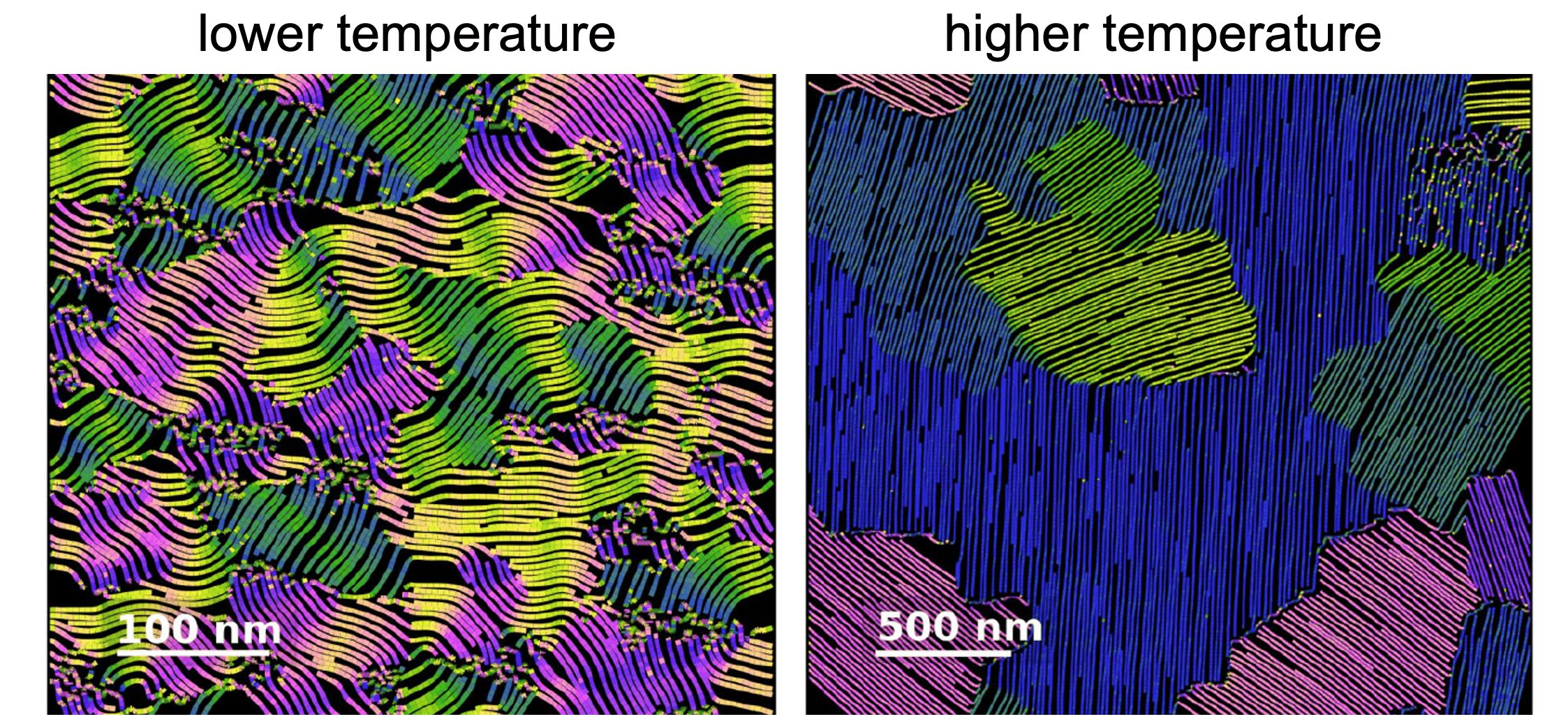
Wisconsin MRSEC researchers have developed a new way to see how molecules fit together with an electron microscope. They used the method to see how molecules rearrange when an organic semiconductor is heated. A modest change in temperature creates significantly improved molecular alignment. The improved alignment is reflected in both larger aligned regions and straighter lines of molecules inside each region.
The alignment of the molecules occurs because higher temperature lets them move to more ordered states. Wisconsin MRSEC researchers are inventing new ways to control molecule mobility, enabling new organic and inorganic materials for a variety of applications.
 Download
Nanoscale View of Alignment and Domain Growth in a Hexagonal Columnar Liquid Crystal

Wisconsin Materials Research Science and Engineering Center
The U.S. National Science Foundation-sponsored Wisconsin Materials Research Science and Engineering Center brings together teams of researchers from diverse disciplinary backgrounds to tackle grand challenges in the materials science of liquids and glasses and non-equilibrium magnetism.