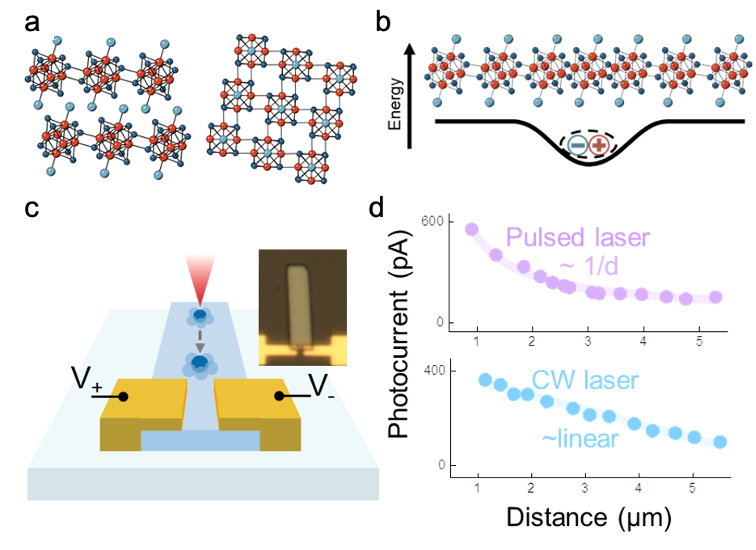
IRG2 has pushed the boundaries of energy transport in superatomic materials, controlling phonon, electron, and exciton interactions. The team published a breakthrough report in Science and several follow up demonstrations of acoustic exciton-polarons quasiparticles in materials, such as the superatomicsemiconductor Re6Se8Cl2 (Fig. 1a,b), which enable ultrafast, phonon-shielded transport, surpassing silicon. The team also uncovered coherent superradianttransport in 1D superatomic crystals. We have now published a theoretical model to explain this new transport behavior.
Building from this, the IRG2 team has fabricated rod-shaped photodetectors (Fig. 1c) and demonstrated that photogenerated acoustic polarons travel over 5 microns, with 1/distance scaling (Fig. 1d, top), confirming lossless, isotropic two-dimensional transport at room temperature. These results enable acoustic polaron transistors, enabling ultrafast, phonon-shielded charge propagation that outperforms conventional semiconductors. Experiments also show continuous-wave excitation generates polaron-driven photocurrents (Fig. 1d, bottom), with distinct transport behavior linked to weak polaron–polaron interactions in steady-state conditions.
 Download
Center for Precision Assembled Quantum Materials (PAQM) (2020)
PAQM encompasses two IRGs that build higher dimensional materials from lower dimensional structures to create the next generation of quantum, optoelectronic, and energy transport materials.