The formation of contractile asters composed of biopolymers is ubiquitous in living systems. In vitro, it is unclear why asters coalescence is slowing down and why asters display either liquid-like or solid-like properties. Sometimes, asters only appear transiently. This knowledge gap is unexplained by current active matter theories and precludes the rational design of steady-state contractile materials.
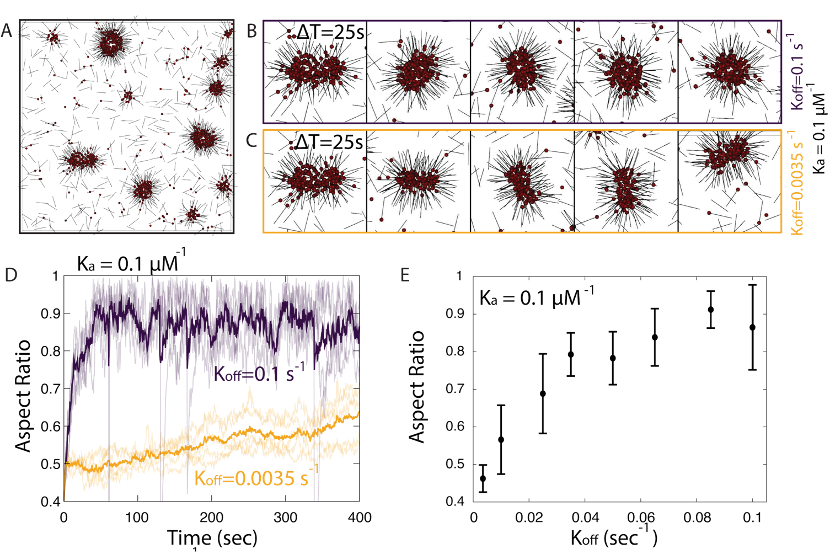
Here, NSF MRSEC IRG2 members Duclos, Baskaran, and Hagancombined experiments and computer simulations to explain the origin of the arrested coalescence, aging, and stability of asters composed of microtubules and molecular motors. They identified the origin of asters’ solidification and developed alternative formulations to assemble liquid-like asters.
Complementary work by Dogic and Fraden investigates how the mechanical contribution of actin filaments impacts the aster’s dynamics.
 Download
Arrested coalescence, aging, and stability of asters composed of microtubules and kinesin motors
.png/thumbcontain)
The Bioinspired Soft Materials Center (2020)
The Brandeis Materials Research Science and Engineering Center (MRSEC) seeks to create new materials that are constructed from only a few simplified components, yet capture the remarkable functionalities found in living organisms.