Bottlebrush block polymers, characterized by densely grafted side chains on a linear backbone, have recently garnered attention. A particularly attractive feature is the accessibility of ordered morphologies with large domain spacings d = 50–500 nm, which is challenging to achieve with linear block polymers.
These large morphologies make bottlebrush block polymers promising for applications, especially, as photonic crystals and optical metamaterials. However, structures achieved in AB diblock bottlebrushes are generally limited to lamellar and cylindrical phases, which restricts potential applications. To address this, UMN MRSEC IRG-2 researchers investigated the self-assembly of ABC bottlebrush block terpolymers.
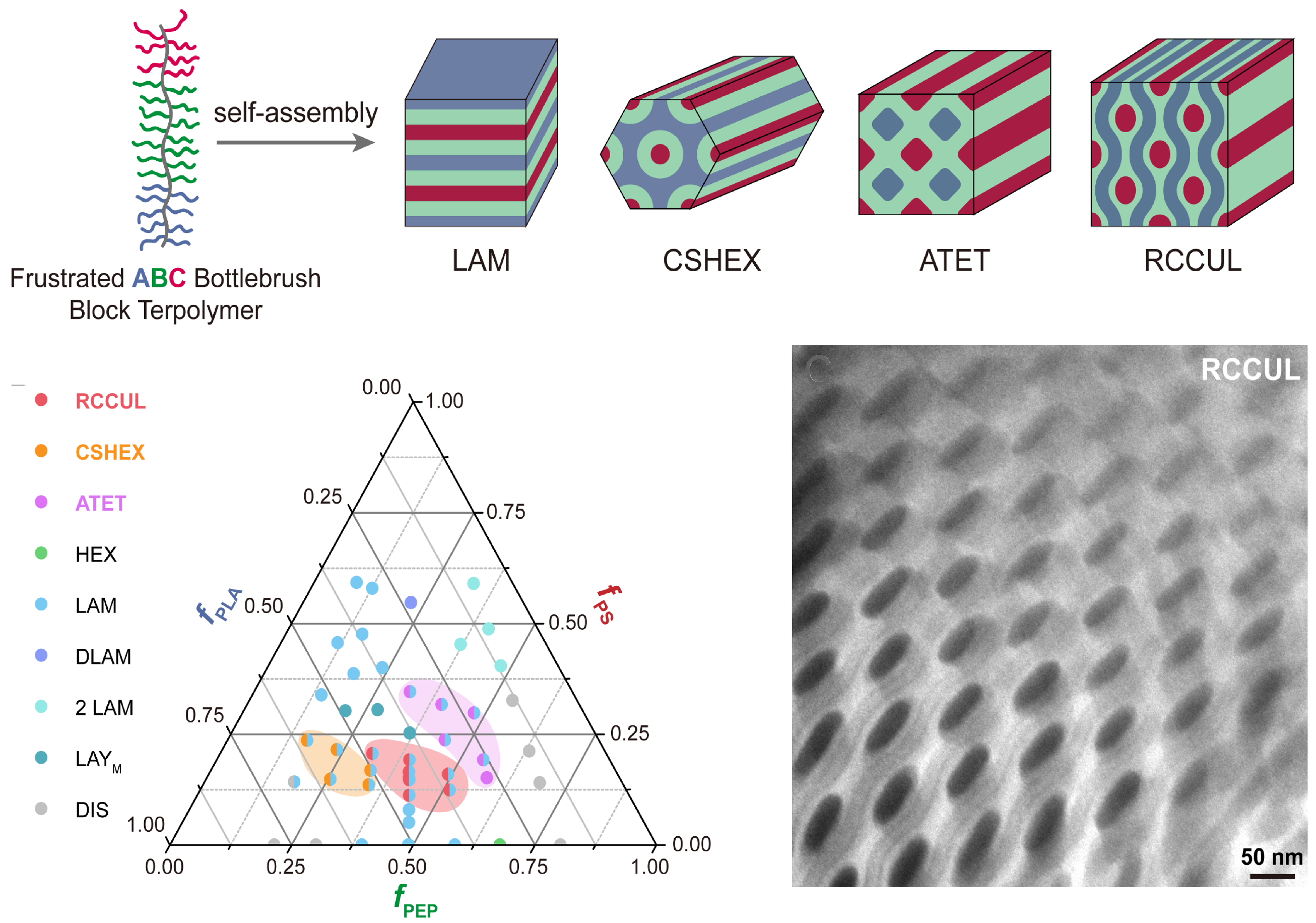
Morphological characterization in collaboration with the Bio-Pacific MIP at UC-Santa Barbara, revealed intriguing mesoscopic structures, including lamellae, core-shell hexagonally packed cylinders (CSHEX), alternating tetragonally packed cylinders (ATET), and an unprecedented morphology, rectangular-centered cylinders-in-undulating-lamellae (RCCUL). Molecular weight variations led to a range of unit cell dimensions (exemplified by RCCUL) from 40 to 130 nm.
This work highlights the abundant potential for multiblock bottlebrushes to create materials with innovative structures and tailored domain dimensions.
 Download
Mesoscopic Morphologies in Frustrated ABC Bottlebrush Block Terpolymers

UMN Materials Research Science and Engineering Center (2020)
This multifaceted NSF MRSEC enables important areas of future technology, ranging from applications of electrical control over materials to scale-invariant shape-filling amphiphile network self-assembly. The UMN MRSEC manages an extensive program in education and career development. The MRSEC is bolstered by a broad complement of over 20 companies that contribute directly to IRG research through intellectual, technological, and financial support. International research collaborations and student exchanges are pursued with leading research labs in Asia and Europe.