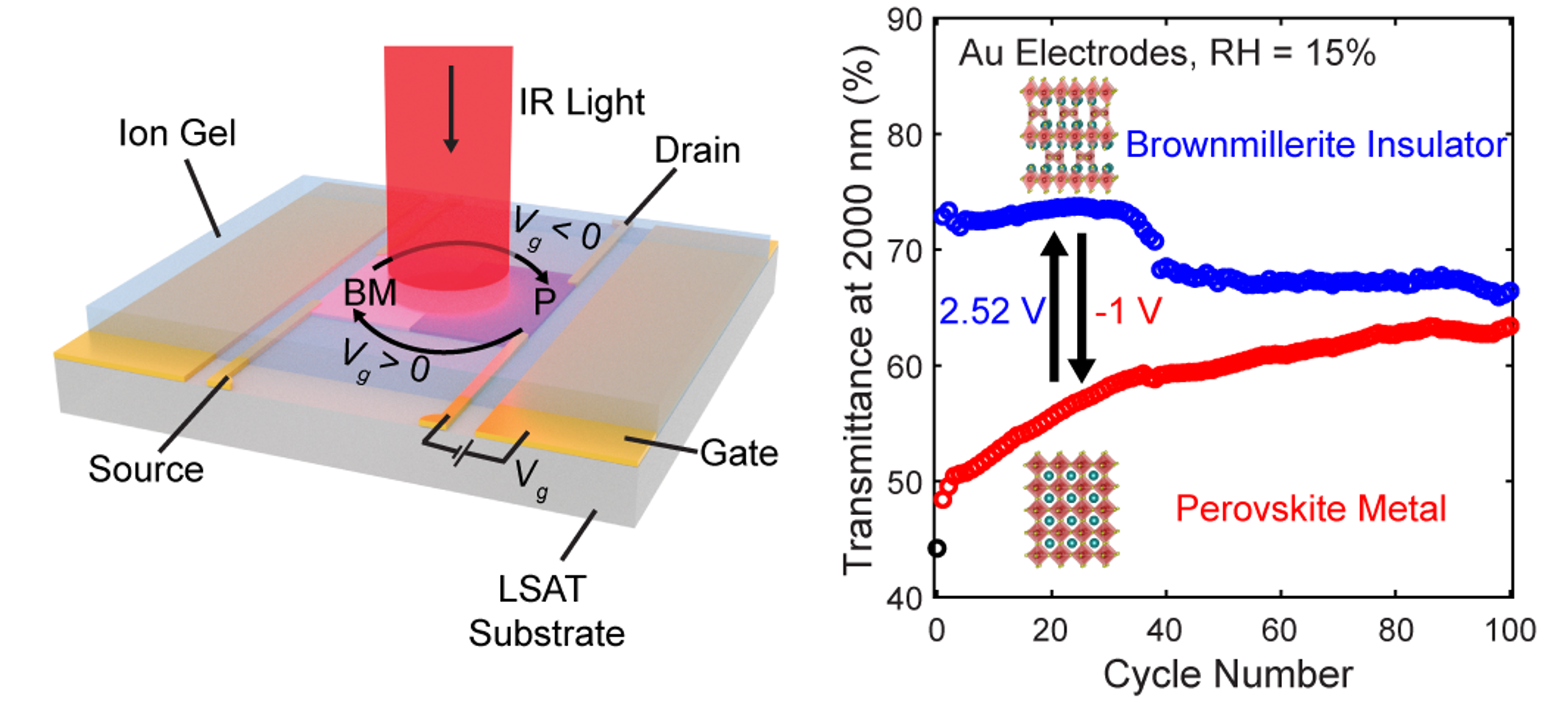
Research in IRG-1 in the UMN MRSEC has brought oxide electrochemical transistors to the verge of applications. Cycling endurance and switching speed are the two final roadblocks to realistic devices. In this period, a collaboration between IRG-1 and a Seed investigator has led to record cycling endurance in ion-gel transistors based on topotactic redox cycling of La0.5Sr0.5CoO3-d (LSCO), improving on previous records by an order of magnitude. LSCO is one of the premier materials for such transistors, as gate-induced oxygen vacancy formation induces a topotactic structure change due to ordering of oxygen vacancies.
The IRG/Seed team applied operando FTIR spectroscopy to probe the optical response of ion-gel gated LSCO during voltage cycling, uncovering a wealth of new mechanistic understanding including about the roles of humidity, device geometry, and electrode metal selection. This enabled optimized devices operating over at least 100 cycles. This sustained modulation of optical properties in the infrared motivates the use of LSCO in thermal camouflage, thermoregulation, and several other applications.
 Download
High Metal–Insulator Topotactic Cycling Endurance in Electrochemically Gated La0.5Sr0.5CoO3−δ Probed by Humidity-Dependent Operando Fourier Transform Infrared Spectroscopy
UMN Materials Research Science and Engineering Center (2020)
This multifaceted NSF MRSEC enables important areas of future technology, ranging from applications of electrical control over materials to scale-invariant shape-filling amphiphile network self-assembly. The UMN MRSEC manages an extensive program in education and career development. The MRSEC is bolstered by a broad complement of over 20 companies that contribute directly to IRG research through intellectual, technological, and financial support. International research collaborations and student exchanges are pursued with leading research labs in Asia and Europe.