Spin liquids are a long-sought-after form of quantum matter, in which basic excitations (spin flips) are “fractionalized” into exotic quasiparticles. The Kitaev honeycomb model is a foundational solvable model that produces Majorana excitations, but finding sharp signatures of these Majoranas has been difficult. So far, experiments have been left to infer their existence by an absence of a sharp signatures in, say, neutron scattering.
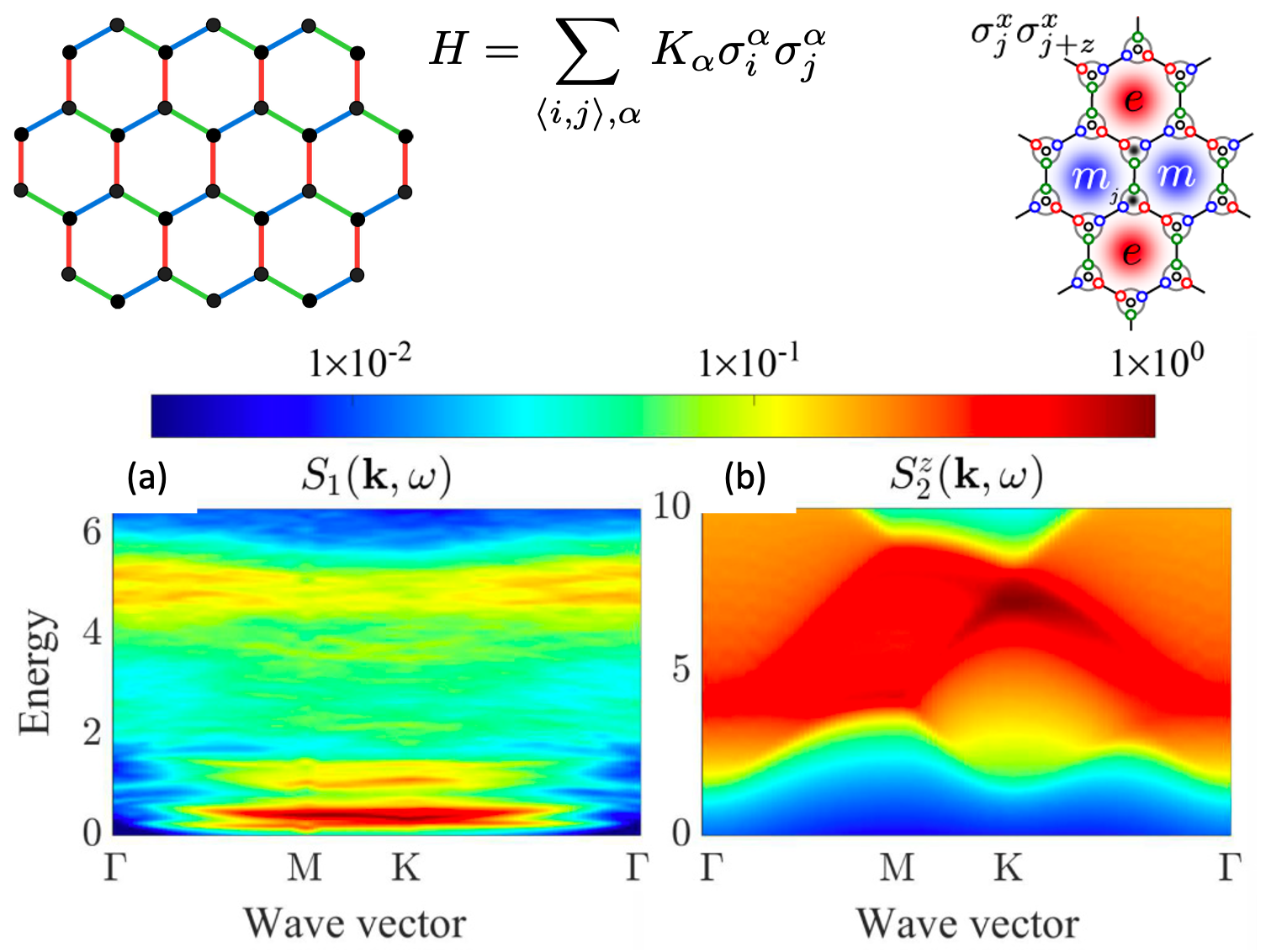
The team has shown, theoretically and numerically, that sharp signatures of Majorana excitations do in fact exist for the Kitaev model with a perpendicular magnetic field, but only in the two-spin-flip excitations. The corresponding two-spin-flip structure factor S_2^z (k,ω) has sharp features that reflect the dispersion of the Majorana excitations.
Our results point to specific experimental methods (for example, nonlinear THz spectroscopy) that can be used to identify these sharp signatures in spin liquid candidate materials.
 Download
Fractionalization signatures in the dynamics of quantum spin liquids

Center for Emergent Materials (2020)
The Center for Emergent Materials (CEM) performs innovative multidisciplinary science focused on discovery and engineering of emergent materials to enable novel phenomena and phases.