Quantum Sensing of Spin Dynamics Using Boron-Vacancy Centers in Hexagonal Boron Nitride
Optically active, spin bearing defects embedded in solid-state systems are appealing for quantum sensing of materials and for quantum science and engineering
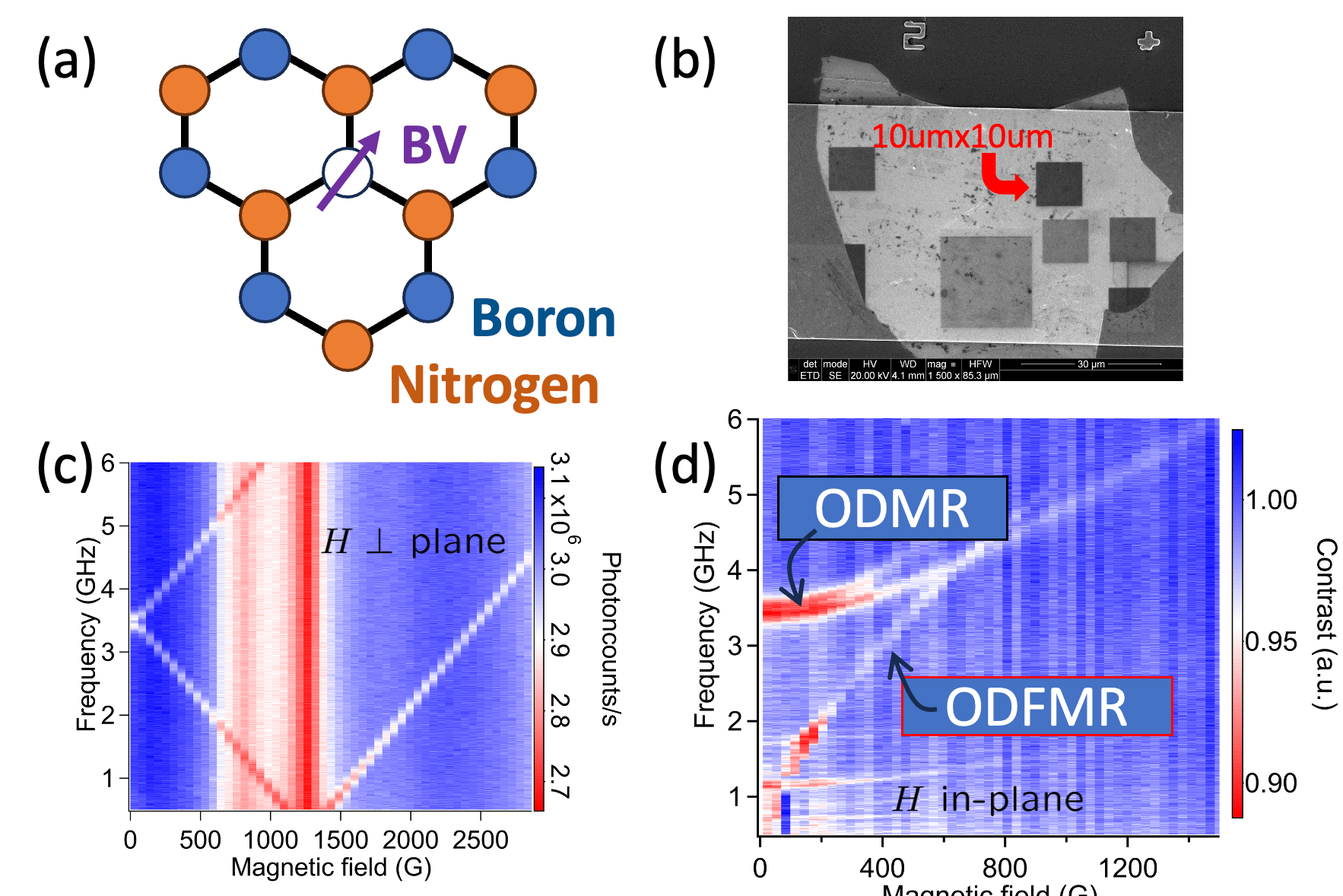
Spin-sensitive photoluminescence of these spin defects in van der Waals based materials, such as the boron-vacancy (BV) centers in hexagonal boron nitride (h-BN), enables spatially localized, quantum sensing of weak static and dynamic magnetic fields
Using relaxometry, the team optically detected ferromagnetic resonance (ODFMR) in yttrium iron garnet (YIG) demonstrating sensitive detection of magnon dynamics
This work establishes BV centers in h-BN as a modular quantum sensing platform that can be seamlessly integrated with emergent and vdW systems to probe a wide range of static and dynamic phenomena
Das, et al., Phys. Rev. Lett 133 166704 (2024)
 Download
Quantum Sensing of Spin Dynamics Using Boron-Vacancy Centers in Hexagonal Boron Nitride

Center for Emergent Materials (2020)
The Center for Emergent Materials (CEM) performs innovative multidisciplinary science focused on discovery and engineering of emergent materials to enable novel phenomena and phases.