•New methods have been developed to load cyanobacteria into shape-shifting materials
•A fundamental understanding of the cyanobacterial interaction with the polymer was gained
•These materials can yield biologically programmable plastics (e.g. self-strengthening, self-healing, therapeutic, etc)
What Has Been Achieved:
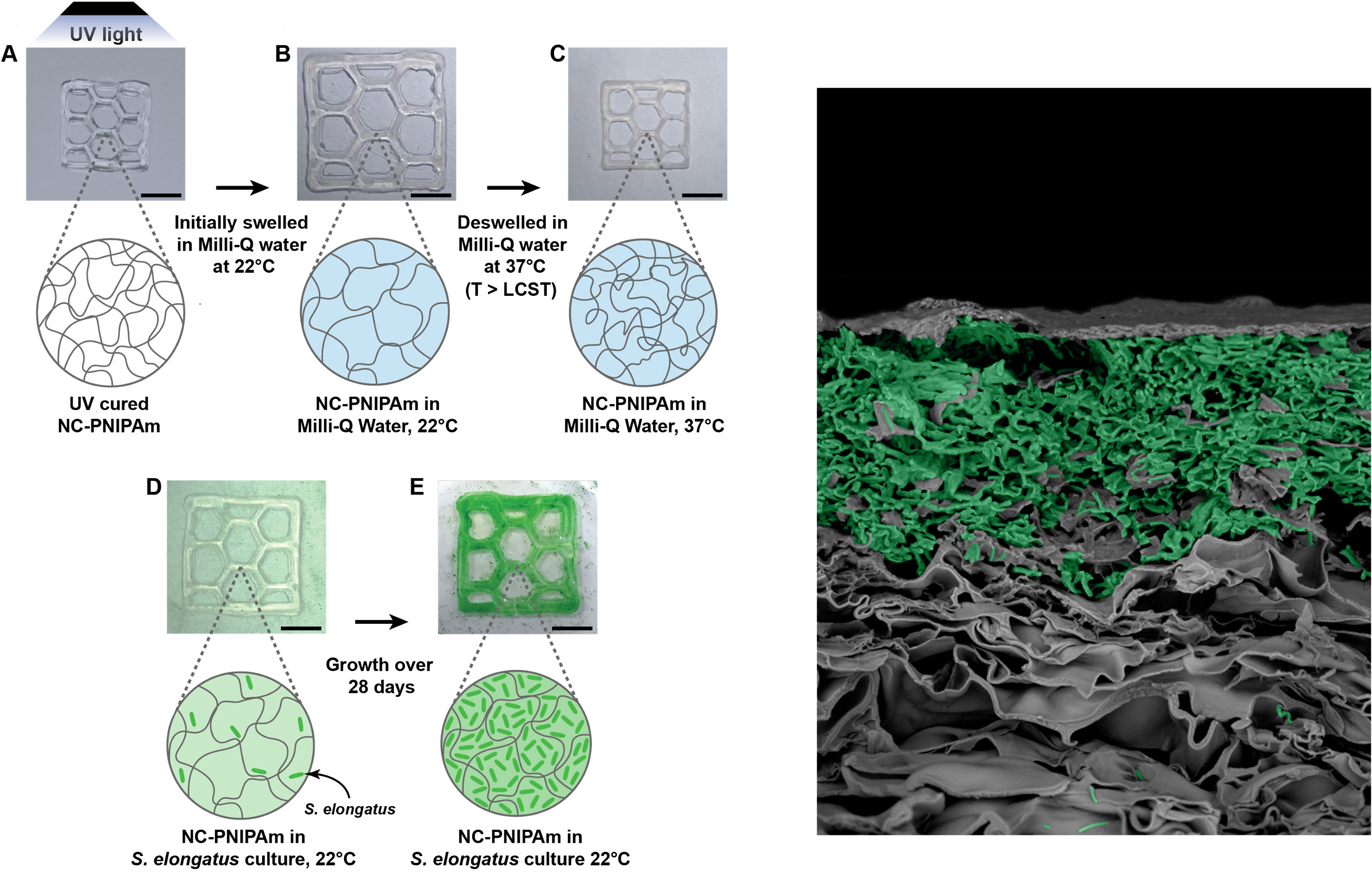
The team developed a temperature-dependent diffusion-based methodology for preparing ELMs that exploits the innate temperature-responsiveness of the nanocomposite hydrogel nanoclay poly(N-isopropylacrylamide). Secondly, the team developed non-equilibrium engineered living materials as the cyanobacteria (Synechococcus elongatus) within the hydrogel was allowed to proliferate for 28-days. Lastly, by observing an engineered living material in non-equilibrium conditions the team witnessed a decrease in the local Young’s modulus, which led to the characterization of a previously undescribed extracellular enzyme, AmiX.
Importance of the Achievement:
Firstly, developing a diffusion-based methodology for preparing engineered living materials is important because it can allow for the addition most microorganisms or other sensitive biological materials to be added into biocompatible polymer scaffolds that are polymerized from cytotoxic precursors. This expands the number of polymer scaffolds that can be used in ELMs. Secondly, observing materials under non-equilibrium conditions is of importance because it can lead to an improved understanding of the biotic/abiotic interface. In this case, studying an ELM under non-equilibrium conditions led to to the characterization of AmiX, an extracellular amidase secreted by Synechococcus elongatus which modulated activity of the ELM. Thirdly, characterization of AmiX is important because it prompts further studies in understanding this extracellular amidase and its role in Synechococcus elongatus, a model cyanobacterium. Ultimately, the team envisions these results paving the way for development of more complex engineered living materials capable of responding to multiple stimuli.
How is the achievement related to the IRG, and how does it help it achieve its goals?
One of the research goals of UCSD MRSEC IRG2 included developing shape-shifting materials driven by asymmetric forces. In this paper the team demonstrated an ELM capable of shape-shifting driven by both a temperature stimulus and enzymatic mediated partial degradation of the composite material. The team concluded the shape-shifting mechanism demonstrated in this paper is a result of an asymmetric mismatch of the Young’s moduli within the ELM. This moduli mismatch is driven by partial enzymatic degradation at the surface of the ELM where cell populations are high.
 Download
A responsive living material prepared by diffusion reveals extracellular enzyme activity of cyanobacteria
.png/thumbcontain)
The Bioinspired Soft Materials Center (2020)
The Brandeis Materials Research Science and Engineering Center (MRSEC) seeks to create new materials that are constructed from only a few simplified components, yet capture the remarkable functionalities found in living organisms.