Super-moiré patterns identified in WSe2 bilayer with large twist angles
Graphene and transition metal dichalcogenide (TMD) bilayers with a small twist angle are known to host flat bands and novel electronic states, correlated insulators, topological insulators, or superconductivity
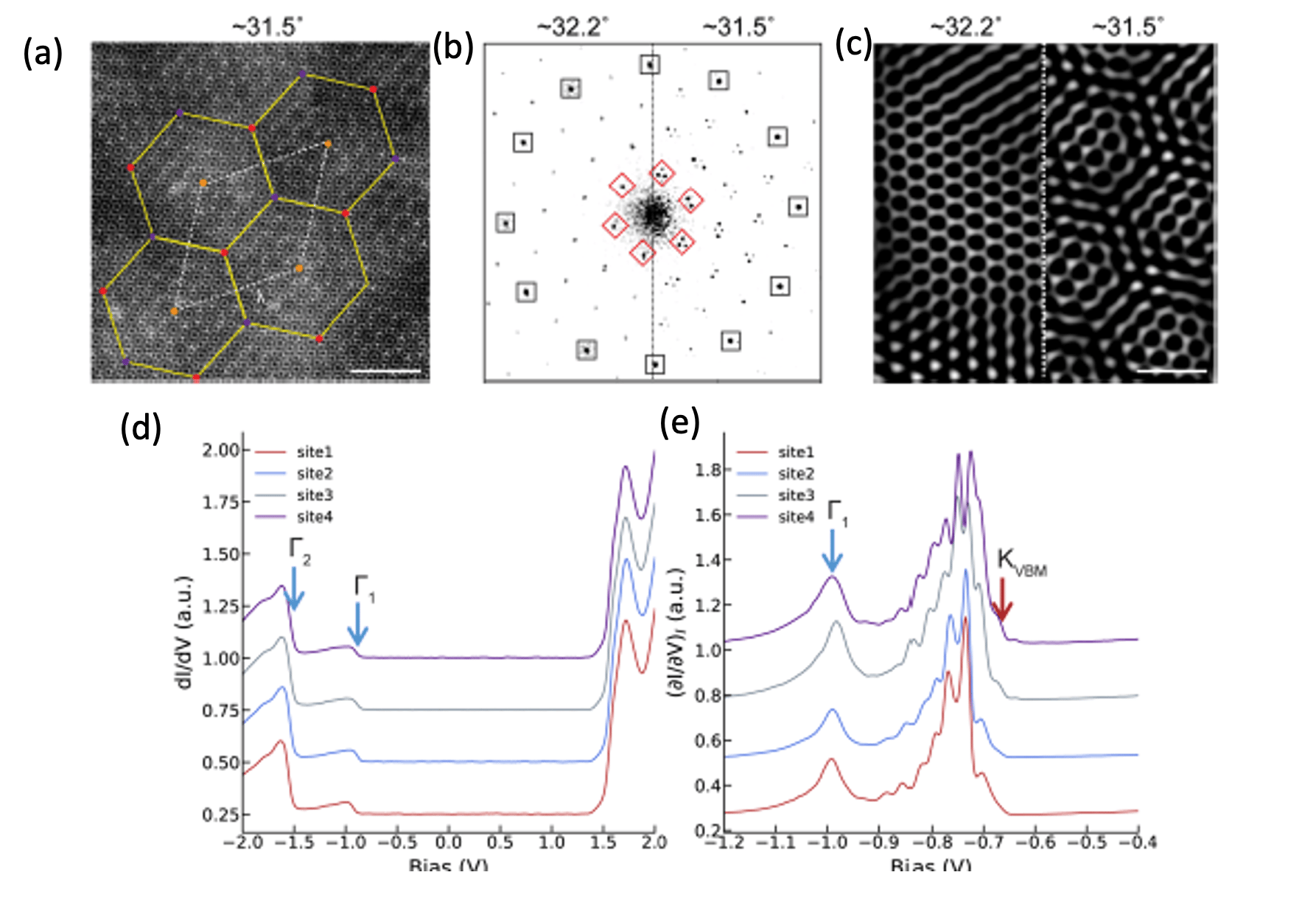
Angle deviation near large commensurate angles (32.2) spontaneously form super-moiré;
Deviation from the commensurate angle determines the second period, directly identified from the TEM spatial images (a,c) and their Fourier transform (b).
Electronic bands from (d) a 32.2º commensurate bilayer and (e) a 31.1º bilayer.
A Super-moiré (e.g. 31.1º and 31.5º bilayer) combining the benefits of the large twisted angle (smooth moire pattern without reconstructions) and small twist angle (narrow electronic bands)
 Download
.png/thumbcontain)
The Bioinspired Soft Materials Center (2020)
The Brandeis Materials Research Science and Engineering Center (MRSEC) seeks to create new materials that are constructed from only a few simplified components, yet capture the remarkable functionalities found in living organisms.