What has been achieved?
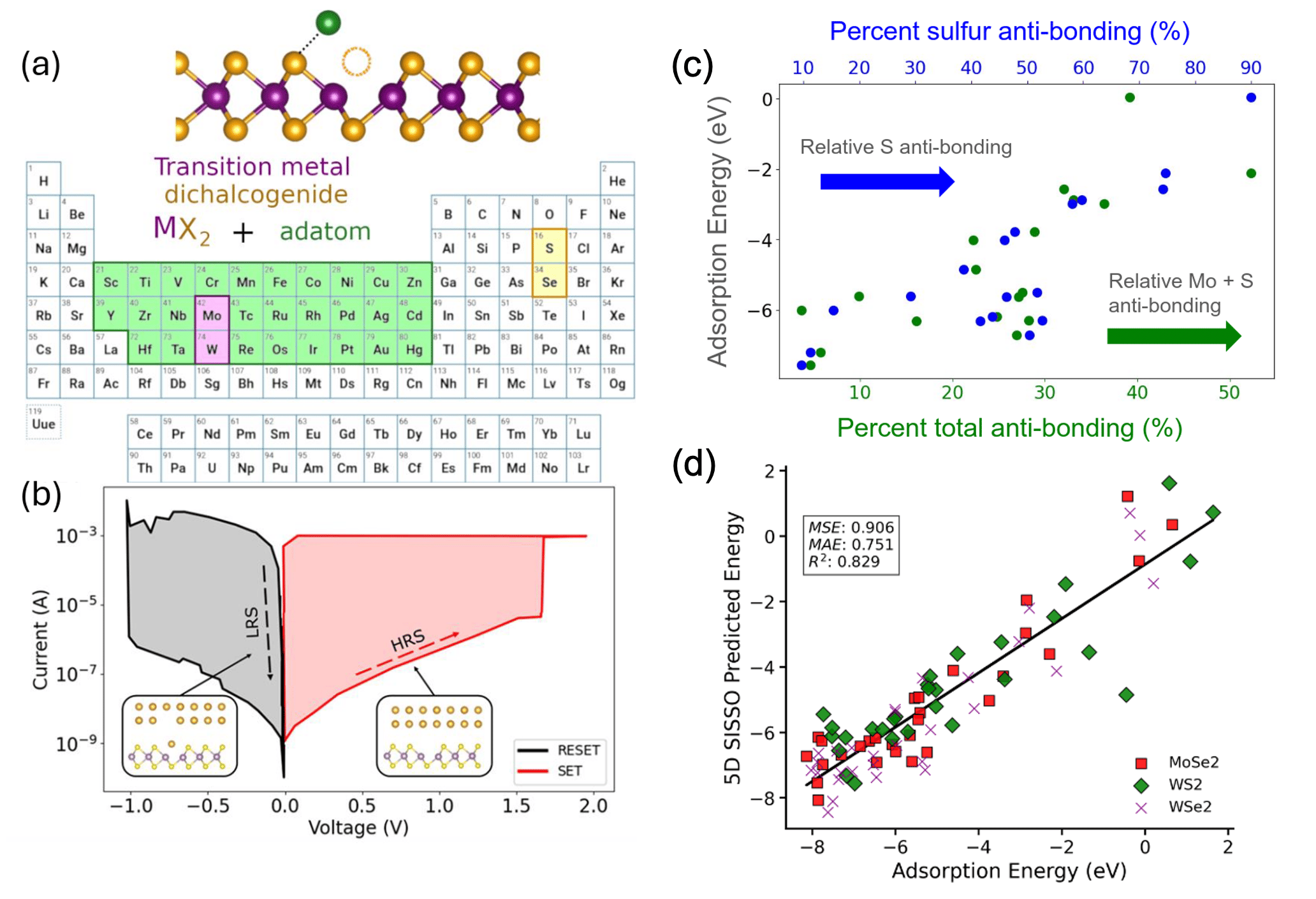
Developed models that predict and explain trends in the defect adsorption energetics for metal adatom adsorption in monolayer TMDs.
These models are based on an understanding of changes in bonding character, hybridization, and electronic structure (e.g., d-band center).
Our simpler and interpretable models perform comparably well to more complex machine learning studies.
Why is this achievement important?
Demonstrate that materials trends exist in the defect energetics and hence switching energetics in resistive switching applications.
Insights provide rational materials selection rules for materials in the active switching layer and the electrodes.
How is the achievement related to the IRG/MRSEC, and how does it help it achieve its goals?
Provides framework for identifying materials trends at defective interfaces in heterostructures involving 2D materials
Understanding defects in 2D materials is critical to their use and operation in electronic devices
 Download
Center for Dynamics and Control of Materials
This NSF MRSEC brings together researchers from across science and engineering to create materials with new atomic-scale structures and functionalities, and to develop approaches for actively controlling and reconfiguring materials in real time.