• Home
  • About
    • Logo Usage Guidelines
    • Program Overview
    • Reports and Guidelines
  • Centers
  • Education & Outreach
  • Highlights
  • News
  • Events
    About
    • Logo Usage Guidelines
    • Program Overview
    • Reports and Guidelines
  • Centers
  • Education & Outreach
  • Highlights
  • News
  • Events
Highlights
Tight Nanostrings Have Better Tone

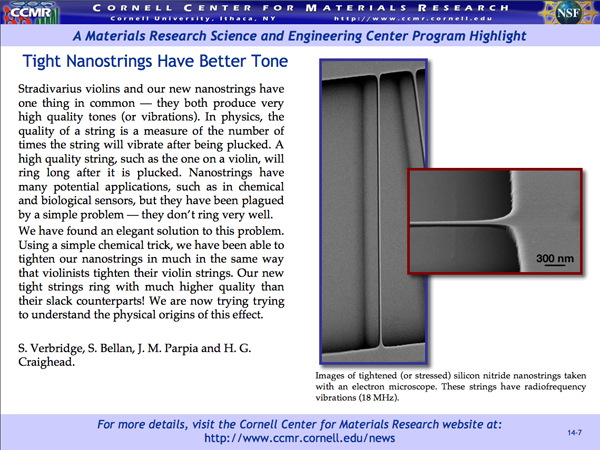
Stradivarius violins and our new nanostrings have one thing in common —they both produce very high quality tones (or vibrations). In physics, the quality of a string is a measure of the number of times the string will vibrate after being plucked. A high quality string, such as the one on a violin, will ring long after it is plucked. Nanostrings have many potential applications, such as in chemical and biological sensors, but they have been plagued by a simple problem —they don't ring very well. We have found an elegant solution to this problem. Using a simple chemical trick, we have been able to tighten our nanostrings in much in the same way that violinists tighten their violin strings. Our new tight strings ring with much higher quality than their slack counterparts! We are now trying tryingto understand the physical origins of this effect.<br /> S. Verbridge, S. Bellan, J. M. Parpia and H. G. Craighead.

Share:

Cornell Center for Materials Research (2017)
National Science Foundation
Any opinions, findings, and conclusions or recommendations expressed on this website are those of the participants and do not necessarily reflect the views of the National Science Foundation or the participating institutions. This site is maintained collaboratively by principal investigators of the Materials Research Science and Engineering Centers awards, independent of the NSF.