• Home
  • About
    • Logo Usage Guidelines
    • Program Overview
    • Reports and Guidelines
  • Centers
  • Education & Outreach
  • Highlights
  • News
  • Events
    About
    • Logo Usage Guidelines
    • Program Overview
    • Reports and Guidelines
  • Centers
  • Education & Outreach
  • Highlights
  • News
  • Events
Highlights
Using Templates to Conquer Disorder

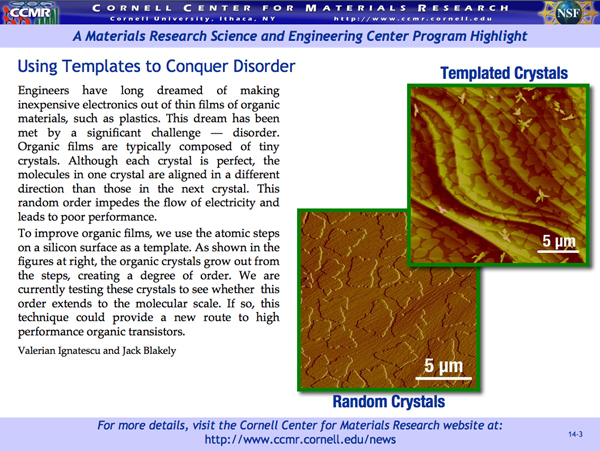
Engineers have long dreamed of making inexpensive electronics out of thin films of organic materials, such as plastics. This dream has been met by a significant challenge —disorder. Organic films are typically composed of tiny crystals. Although each crystal is perfect, the molecules in one crystal are aligned in a different direction than those in the next crystal. This random order impedes the flow of electricity and leads to poor performance.<br /> To improve organic films, we use the atomic steps on a silicon surface as a template. As shown in the figures at right, the organic crystals grow out from the steps, creating a degree of order. We are currently testing these crystals to see whether this order extends to the molecular scale. If so, this technique could provide a new route to high performance organic transistors.<br /> Valerian Ignatescu and Jack Blakely

Share:

Cornell Center for Materials Research (2017)
National Science Foundation
Any opinions, findings, and conclusions or recommendations expressed on this website are those of the participants and do not necessarily reflect the views of the National Science Foundation or the participating institutions. This site is maintained collaboratively by principal investigators of the Materials Research Science and Engineering Centers awards, independent of the NSF.