• Home
  • About
    • Logo Usage Guidelines
    • Program Overview
    • Reports and Guidelines
  • Centers
  • Education & Outreach
  • Highlights
  • News
  • Events
    About
    • Logo Usage Guidelines
    • Program Overview
    • Reports and Guidelines
  • Centers
  • Education & Outreach
  • Highlights
  • News
  • Events
Highlights
Graphene Membranes: Atomically Thin Balloons

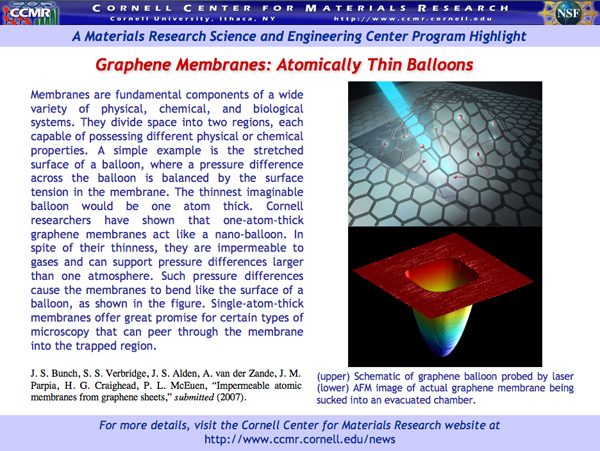
Membranes are fundamental components of a wide variety of physical, chemical, and biological systems. They divide space into two regions, each capable of possessing different physical or chemical properties. A simple example is the stretched surface of a balloon, where a pressure difference across the balloon is balanced by the surface tension in the membrane. The thinnest imaginable balloon would be one atom thick. Cornell researchers have shown that one-atom-thick graphene membranes act like a nano-balloon. In spite of their thinness, they are impermeable to gases and can support pressure differences larger than one atmosphere. Such pressure differences cause the membranes to bend like the surface of a balloon, as shown in the figure. Single-atom-thick membranes offer great promise for certain types of microscopy that can peer through the membrane into the trapped region. J. S. Bunch, S. S. Verbridge, J. S. Alden, A. van der Zande, J. M. Parpia, H. G. Craighead, P. L. McEuen,

Share:

Cornell Center for Materials Research (2017)
National Science Foundation
Any opinions, findings, and conclusions or recommendations expressed on this website are those of the participants and do not necessarily reflect the views of the National Science Foundation or the participating institutions. This site is maintained collaboratively by principal investigators of the Materials Research Science and Engineering Centers awards, independent of the NSF.