In multiferroic materials, where magnetism and ferroelectricity coexist, it is possible to excite mixed spin and lattice vibrations with electromagnetic waves called electromagnons. We find that the mechanism responsible for electromagnons is different from the one that couples static magnetism and ferroelectricity. Our results show how the strong coupling of spin and lattice excitations produce the colossal electromagnon observed in RMnO3. This mechanism can also exist in non-multiferroic materials.
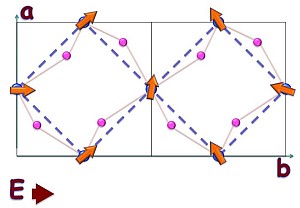
Above: Displacements of the oxygen ions (pink) modulates the super exchange between Mn ions (blue) which couples the magnons with the phonons.
UMD Materials Research Science and Engineering Center (2005)
The Maryland MRSEC carries out nationally recognized fundamental research on surfaces and interfaces of materials with potential impact on the next generation of opto- and nano-electronic devices, and on complex oxides with potential applications in memory, switches, and sensors.