• Home
  • About
    • Logo Usage Guidelines
    • Program Overview
    • Reports and Guidelines
  • Centers
  • Education & Outreach
  • Highlights
  • News
  • Events
    About
    • Logo Usage Guidelines
    • Program Overview
    • Reports and Guidelines
  • Centers
  • Education & Outreach
  • Highlights
  • News
  • Events
Highlights
The Best Sandwiches are Not the Most Perfect Sandwiches

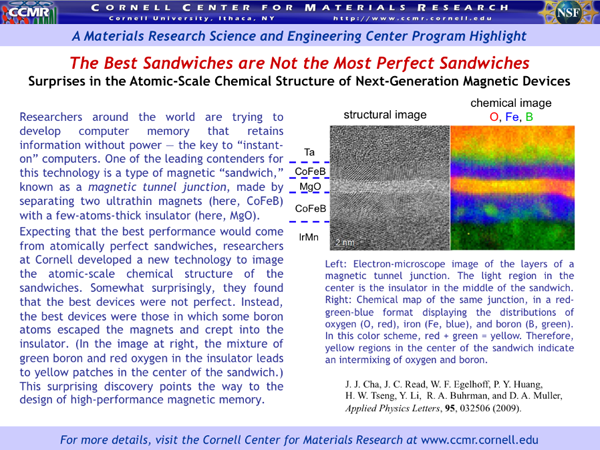
Surprises in the Atomic-Scale Chemical Structure of Next-Generation Magnetic Devices   Researchers around the world are trying to develop computer memory that retains information without power — the key to “instant-on” computers. One of the leading contenders for this technology is a type of magnetic “sandwich,” known as a magnetic tunnel junction, made by separating two ultrathin magnets (here, CoFeB) with a few-atoms-thick insulator (here, MgO). Expecting that the best performance would come from atomically perfect sandwiches, researchers at Cornell developed a new technology to image the atomic-scale chemical structure of the sandwiches. Somewhat surprisingly, they found that the best devices were not perfect. Instead, the best devices were those in which some boron atoms escaped the magnets and crept into the insulator. (In the image at right, the mixture of green boron and red oxygen in the insulator leads to yellow patches in the center of the sandwich.) This surprising discovery points the way to the design of high-performance magnetic memory.

Share:

Cornell Center for Materials Research (2017)
National Science Foundation
Any opinions, findings, and conclusions or recommendations expressed on this website are those of the participants and do not necessarily reflect the views of the National Science Foundation or the participating institutions. This site is maintained collaboratively by principal investigators of the Materials Research Science and Engineering Centers awards, independent of the NSF.