As electronic devices shrink deep into the nano-scale, low-resistivities become essential. Simply put, electrons scatter off surfaces, and surfaces are closer together in small devices. Mazin Maqableh of IRG-3 has worked with Professors Stadler and Victora to develop ultra-small (10nm) magnetic sensors and associated electrodes with low resistivities enabled by very smooth surfaces. These resistivities are 10-1000x lower than both predictions and those found in nanowires made by other means. These magnetic sensors had high signals,, 25 W total resistance, and high switching currents that met or exceeded all parameters of competing sensors, which are approximately 10 x larger.
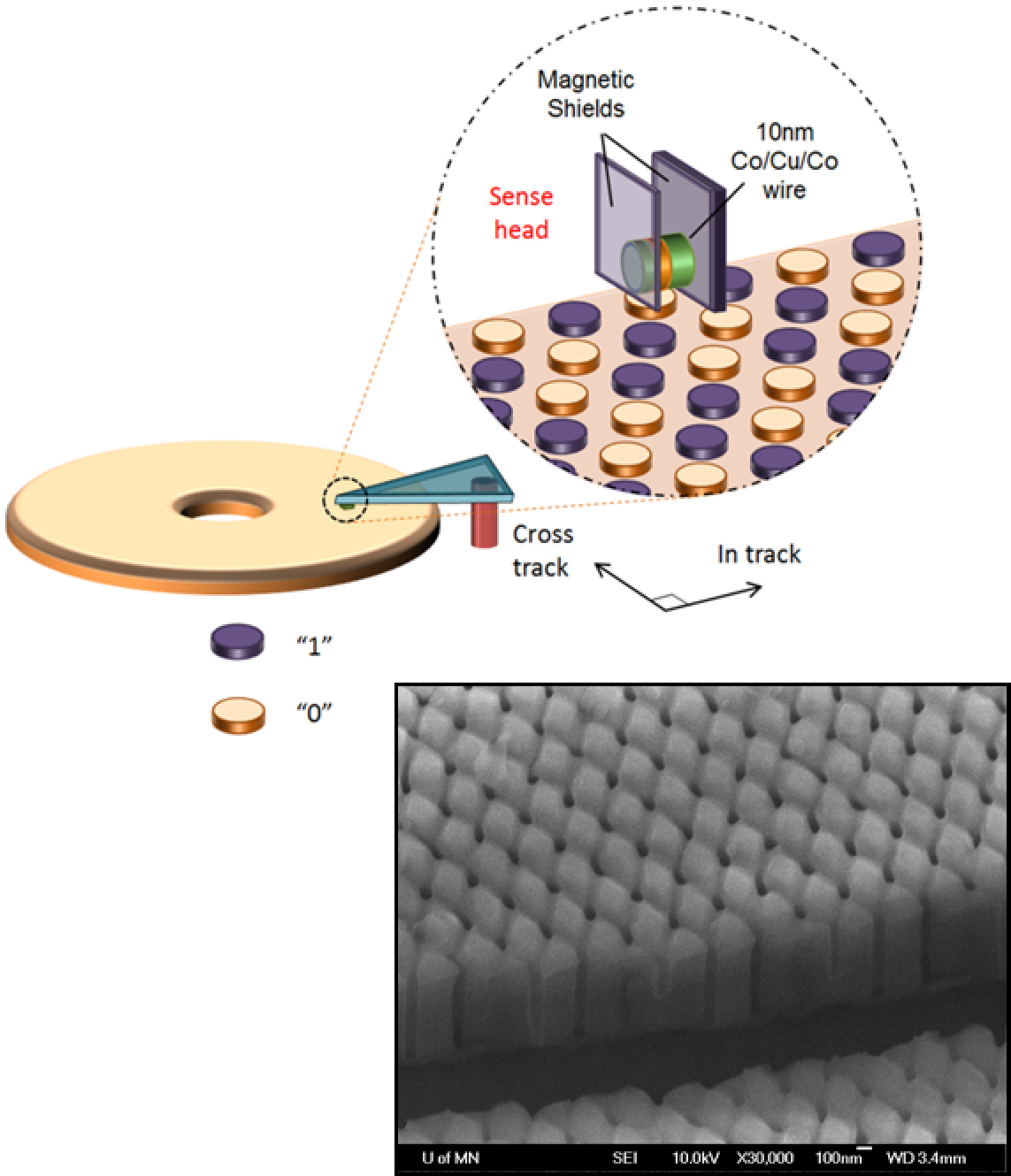

(a)  Schematic of 10-nm diameter Co/Cu/Co nanowire in a read sensor application. Despite being 4x smaller than the bulk scattering length for electrons, these nanowires exhibit almost bulk resistivities due to the very smooth surfaces of the aluminum oxide growth template.  (b) Micrograph showing templates with smooth sidewalls and long range ordering (over in2).
(a) Schematic of 10-nm diameter Co/Cu/Co nanowire in a read sensor application. Despite being 4x smaller than the bulk scattering length for electrons, these nanowires exhibit almost bulk resistivities due to the very smooth surfaces of the aluminum oxide growth template. (b) Micrograph showing templates with smooth sidewalls and long range ordering (over in2).